TL;DR — Lenskart Case Study Snapshot
| Lenskart was founded in 2010 by Piyush Bansal and is now valued at $5.6 to $6.1 billion (2024-2025) |
| Revenue shot up to ₹6,653 crore in FY25, jump of 23% from last year. |
| Operates 2700+ stores globally. |
| Lenskart holds 41% of shares in India’s organised eyewear market. |
| Lenskart’s success story depends on omnichannel marketing strategy, D2C pricing strategy, latest technology and digital marketing strategy. |

The India Eyewear Problem Lenskart Solved
Lenskart case study is perfect example to show how small startup can totally change unorganised eyewear industry. To understand Lenskart success story, we need to go back to the time before 2010. If you needed eyeglasses, your options are limited to local opticians.
People had zero fashion sense and almost no sense of styling, pricing and branding. Then Piyush Bansal along with Amit Choudhary and Sumeet Kapahi entered in eyewear industry in India. They catch gap that eyewear is not only medical need but is now treated as lifestyle product. Piyush Bansal quit his job at Microsoft in Canada and decided to come back to India with their co founders.
Lenskart Expansion: 15 Year Journey in Numbers
Their journey from 30 customers in a day to 3000+ customers daily in 2026 is combination of strong Lenskart business model and digital marketing strategy.
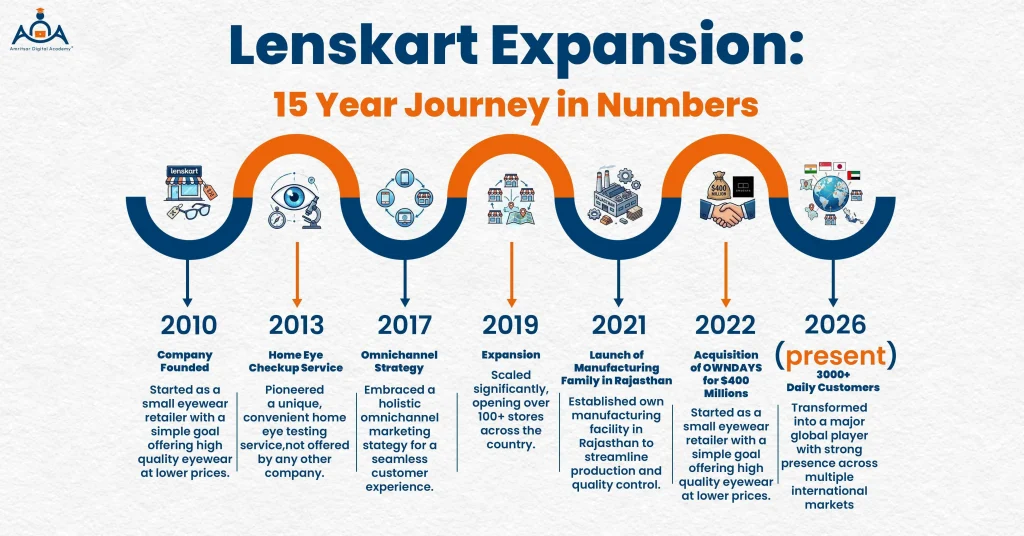
- Company started with small eyewear retailer by offering lower prices.
- Then in 2013, they introduced home eyecheckup service, which is not served by any other company.
- Lenskart uses 3D technology where users can try eyewear virtually.
- In 2017, Lenskart followed omnichannel marketing strategy.
- Lenskart opened 100+ stores across the country in 2019.
- In 2020, company start their own manufacturing facility in Rajasthan.
- Lenskart acquired controlling stake in Japanese eyewear retail chain OWNDAYS for $400 million.
- In 15 years, company set up their global omnichannel powerhouse with presence across India, Singapore, Japan, UAE, and Southeast Asia.
| Expert Analysis: In Indian consumer technology, the Lenskart case study is a prime illustration of founder market fit. Piyush Bansal created whole ecosystem to bridge the trust and product gaps. The outcome is marketing masterclass that should be studied by all Indian D2C brands. |
Lenskart Business Model: How Lenskart Makes Money
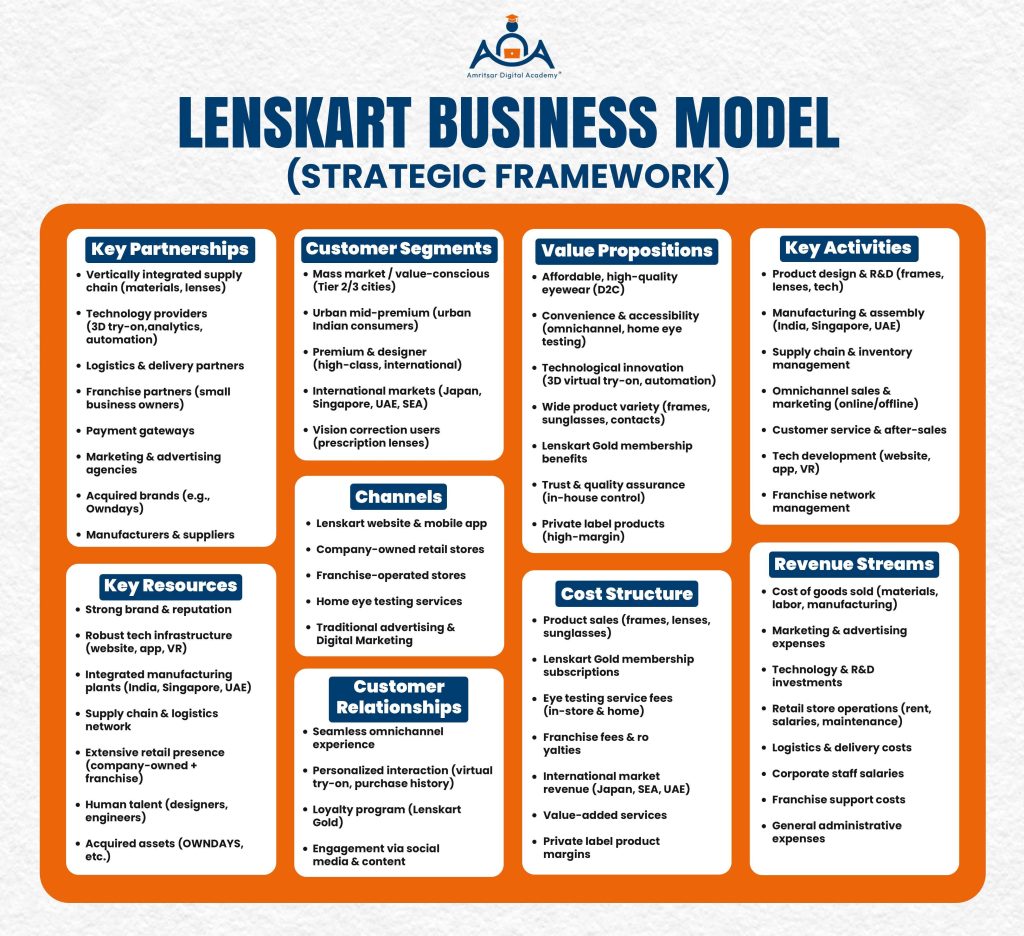
Lenskart business model is built on D2C brand approach combined with strong omnichannel retail strategy. This means Lenskart controls the entire value chain, from manufacturing to sales, eliminating intermediaries and reducing costs. Here is complete Lenskart business model:
Vertical Integration Play
Most eyewear brands in India source their products from third party manufactures. This results in higher prices and limits control over quality. But Lenskart chose different route. They own its entire value chain from manufacturing to delivery. This vertical integration makes Lenskart business model highly profitable.
Company operates its own manufacturing plant in India and also has facilities in Singapore and the UAE. By eliminating middlemen, Lenskart offers high quality products at affordable prices to budget conscious consumers.
Lenskart Revenue Sources
- Product Sales: Primary source of earnings for Lenskart is selling eyewear products, includes sunglasses, prescription glasses, and contact lenses. Lenskart offers wide range of variety and styles according to customer needs and budget.
- Membership Service: Lenskart introduced ‘Lenskart Gold’ subscription for its customers. They offer discounts and special offers to their Lenskart Gold membership holders to maintain customer loyalty and generate recurring revenue.
- Eye Testing Service: Lenskart offers eye test service at retail stores and also home visits by professional opticians. They offered these services at very nominal or free cost, which encourages purchase of eyewear products and indirectly contributes to revenue.
- Franchises: Lenskart expand their physical stores with franchise model. They partnered with small business owners to open new stores. They earn from franchise fees and share of sales from these outlets.
- International Revenue: Lenskart’s 42% of income is from international market. They generate revenue from Japan, Singapore, UAE, and Southeast Asia. This varied Lenskart business model shows that Lenskart did not depend on only one source of income.
Lenskart Pricing Strategy
The way Lenskart manages its pricing strategy is another solid feature of its business model. They did not only rely on single price point, Lenskart operates across three tiers:
| Pricing Strategy | Price Range | Target Customer |
| Budget tier | Starting range from Rs 999. | For first time buyers and tier 2/3 city customers. |
| Mid premium | Rs 1500 to Rs 4000 | For urban Indian consumers |
| Premium and designers | Rs 4000 and above | For high class and international customers |
Their famous ‘Buy 1 Get 1 Free’ offer is major conversion lever especially for new customers.
Lenskart Omnichannel Retail Strategy: The Phygital Masterclass
Lenskart creates different identity from other D2C brands by its commitment to omnichannel retail strategy that company calls ‘phygital’. They focus on both physical and online retail stores. Lenskart built its largest offline store network in India.
Why Lenskart go offline when everyone is going online?
The answer is Lenskart studies customer behaviour and demand for products that require physical interaction. Eyewear products are not like books or electronic products. People spend money only when they have tried product on their face.
Lenskart knows:
- Prescription needs verification
- Frames need to be tried on
- Customers need professional assurance before they spend on something they will wear daily on their face.
| Thatswhy the result: Lenskart now operates 2700+ stores globally and plans to add more. |
Lenskart Omnichannel Model
The omnichannel retail strategy of Lenskart relies on six pillars that satisfy customer experience.
- Website and App: Lenskart has 50M+ app downloads and 4.2M website organic traffic which is higher conversion engine.
- 2700+ Physical Stores: The company encourages sales offline by building trust, provide trails and capturing prescription based customers.
- Home Eye Checkup Service: Lenskart follows customer acquisition strategy by sending professional opticians to customer home.
- Free Eye Checkups at Stores: Lenskart offers free eye tests at its stores. This result drives more sales especially new customers.
- Blinkit Partnership: Lenskart partnered with Blinkit and provide 10 minutes contact lens delivery for urgent needs.
- Return Policy: The company offers seamless return policy to their cutomers. That means customers can buy online and return to their offline stores. This satisfying customer experience built strong connections and loyalty.
Lenskart Marketing Strategy: Full Breakdown
Lenskart marketing strategy does not depend only on single effort. It is multi layered marketing strategy that is combined with digital precision with human storytelling. It is combination of performance marketing with strong content, SEO with influencer campaigns, and digital channels with traditional media. The result is brand achieve omnipresent and builds loyalty, trust and repeat purchases.
In this Lenskart case study, let’s analyse Lenskart’s marketing strategy in detail:
Lenskart SEO and SEM Playbook
From SEO and SEM point of view, Lenskart establish strong online presence in Indian searches. The brand ranks number one with its branded keywords and Lenskart website has strong domain authority of 68. They reached 4.3M organic traffic in March 2026, making organic search significant and cost efficient marketing channel.
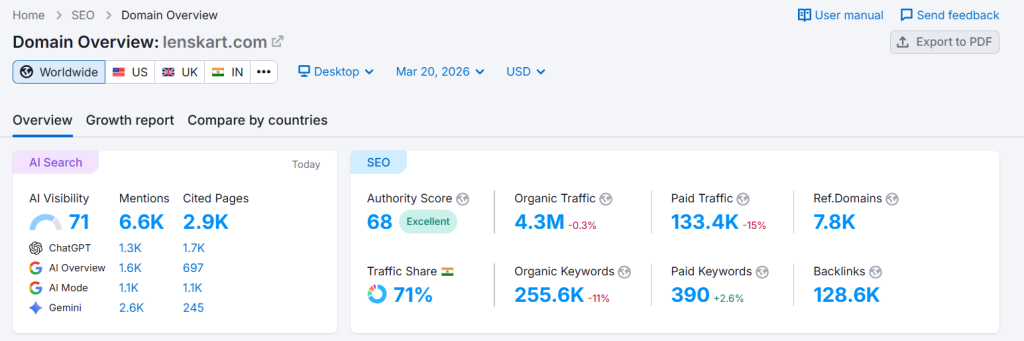
Lenskart runs Google shopping ads, retargeting campaigns and mix of branded and non branded search campaigns. Their digital marketing strategy ensures that Lenskart capture demand of audience at every stage. They target users searching for ‘cheap eyewear glasses’ to those specifically searching for ‘Lenskart Gold Membership’. This full SEM funnel of Lenskart digital marketing campaigns drives consistent growth.
How Shark Tank India Became Lenskart’s Free Advertisement
One of the smartest moves by Lenskart in its customer acquisition strategy is Piyush Bansal’s role as judge on Shark Tank India.
- His regular presence on show,
- Offering strong business insights,
- Negotiating live on TV, and
- Naturally mentioning Lenskart in context.
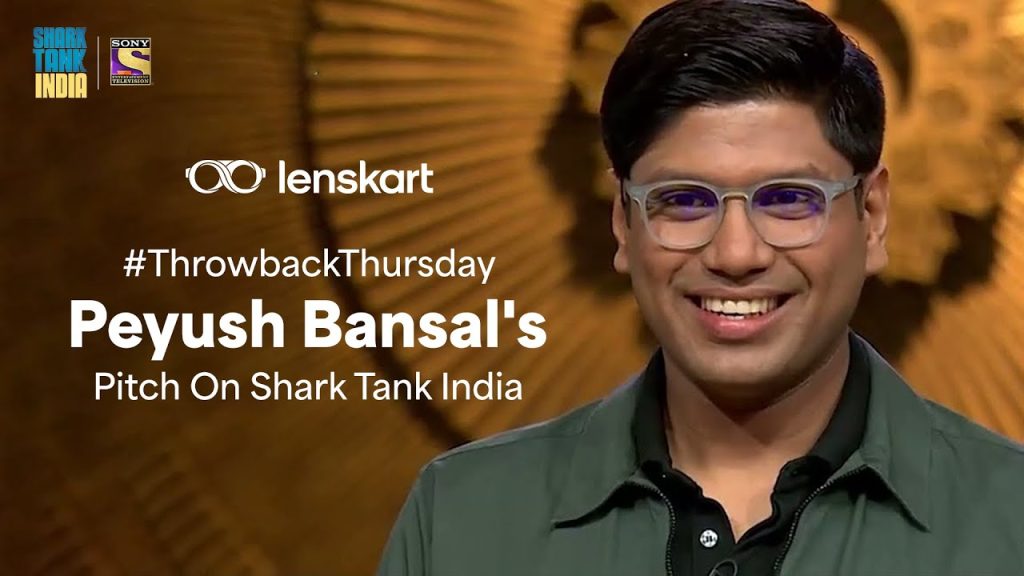
All of these gave brand millions of rupees with organic brand building that no media spend can do. Indian consumers trust brand more when they can associate face and story with it. Shark Tank was not calculated marketing campaign in Lenskart success story. It was authentic move that paid dividends that are difficult to quantify.
Influencer Marketing Strategy of Lenskart: From Karan Johar to Bhuvan Bam
Lenskart marketing strategy always treated influencer marketing as its main source of marketing channels. Celebrity collaborations with Karan Johar, Kiara Advani, and Katrina Kaif give brand aspirational appeal in premium segment. Lenskart also collaborates with digital personalities like Bhuvan Bam that target youth market with authenticity and reliability.
Viral Marketing Campaigns by Lenskart
#KaranVsPeyush (The War of Fair Prices)
The most talk about all Lenskart digital marketing campaigns is KaranVsPeyush. In this campaign, they show collaboration between Karan Johar and Peyush Bansal. This campaign is designed in humour with product education in way that feels organic and entertaining. This campaign went viral on social media and attracted sales by highlighting value for money.
#HalkaRakhYaar
Most of the eyewear is heavy and uncomfortable but Lenskart changes this perception. Through ‘HalkaRakhYaar’ campaign, they promote their lightweight frames. This campaign shows comparison between heavy eyewear and Lenskart’s lightweight frames. With this campaign, Lenskart solves consumer problem and drive conversions.
Nazar Ghati, Durghatna Ghati Marketing Campaign
This campaign is not only for sale purposes; it creates social awareness as well. This campaign gave message that weak eyesight can cause accidents so regular eye tests are required for everyone. Its combination of brand promotion and social responsibility.
#SeeTheLove (Pride 22)
This campaign launched during Pride month, June 2022. Lenskart gives message of encouragement to people to look beyond labels and prejudice through this campaign. The main aim of this campaign is to connect with Gen Z and millennials by supporting diversity.
Lenskart Performance Marketing: Data, Targeting and ROI
Behind viral videos and celebrity campaigns lies performance marketing engine. They use behavioural segmentation to serve ads based on history, purchase, and location behaviour.
- They target lookalike audiences on Meta and Google to find new customers that resemble existing ones.
- They work on A/B testing and run multiple creative variations.
- Budget shifted in real time to best performers.
| Lenskart performance marketing strategy converted digital intent into offline store visits. This is very rare capability that very few D2C brands have mastered at scale. This gap between online visibility and in-store conversion is what makes Lenskart case study unique. |
Also Read: Amazon Case Study: How Amazon Built a Relentless Growth Strategy
SWOT Analysis of Lenskart
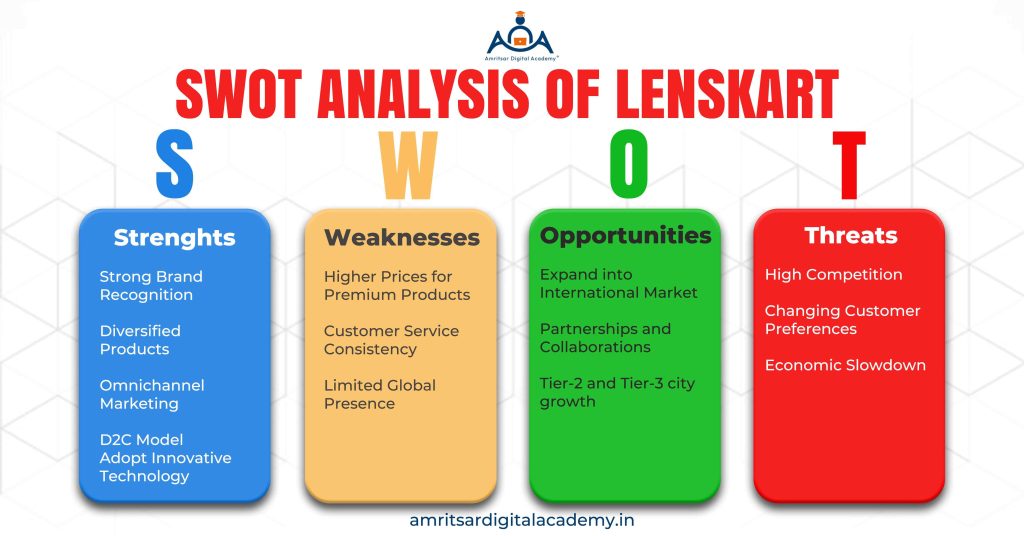
S = STRENGTHS
W = WEAKNESSES
O = OPPORTUNITIES
T = THREATS
Strengths
- Strong Brand Recognition: Lenskart has strong brand presence in India and abroad. People know them for quality products and solid customer service, this kind of experience that brings customers back.
- Diversified Products: Lenskart offers wide range of eyewear products, including sunglasses, prescription glasses, and contact lenses. This wide variety serves broader audience according to their needs.
- Omnichannel Marketing: Lenskart establish their presence in both online and offline stores. They focus on omnichannel retail strategy so customers can select product online and try it on by visiting store.
- D2C Model: The company eliminates third party manufactured products and establishes its entire value chain. With D2C model they provide higher quality products at affordable prices to their customers.
- Adopt Innovative Technology: Lenskart integrates technology into customers shopping experience. With virtual try on feature, customers can try eyewear without wearing product physically.
Weaknesses
- Higher Prices for Premium Products: Lenskart has established reputation for quality and innovation by providing variety of fashionable eyewear options, its premium products are quite expensive. Price conscious consumers may be turned off by this pricing strategy and choose more reasonably priced goods from competitors.
- Customer Service Consistency: Continuous expansion of new stores sometimes leads to inconsistent service support after sale.
- Limited Global Presence: Lenskart needs to establish its stores globally to maintain its position in eyewear industry.
Opportunities
- Expand into International Markets: Lenskart has established its strong presence in the Indian eyewear market but there is significant potential for global expansion. Targeting emerging markets could bring substantial growth, considering the increasing awareness of eye health and the demand for eyewear in these regions.
- Partnerships and Collaborations: Lenskart can expand its market reach by forming partnerships with various sectors such as healthcare, technology companies and fashion brands. Collaborate with eye checkup camps that shows brand identity and its responsibility that cares about eye health.
- Tier-2 and Tier-3 city growth: There is opportunity to penetrate small cities where eyewear sales remain underdeveloped.
Threats
- High Competition: Lenskart is not only brand in eyewear industry. Their competitors – Titaneye+, Reliance and many more give strong competition. Lenskart has to maintain its unique selling propositions and innovate more products.
- Changing Customer Preferences: Customer change their preferences according to trends. So align product offerings with trends and consumer preferences to avoid loss of engagement and sales.
- Economic Slowdown: In recession period, people avoid extra expenses. This may affect sales of company. So employ various pricing strategies and promotional offers to maintain sales momentum during this period.
Marketing Lessons From Lenskart Case Study
When you look back at the full arc of the Lenskart case study, you will realise that there are lessons that apply not only to eyewear brands but also to any business that wants to establish its position in the market.
| Lesson 1: Lenskart’s vertical integration smart move controls its costs, quality and margins in way that competes with competitors. Where prices are high in the market, Lenskart’s own manufacturing provides cost advantage. |
| Lesson 2: The company proves that omnichannel is not optional for categories that require physical trust. Lenskart’s business model shows offline and online are not competitors; they complement each other. |
| Lesson 3: Lenskart did not just build only company. It built brand with personality, founder face, emotional connection with Indian consumers. The digital marketing strategy, Shark Tank visibility, viral campaigns, and influencer marketing all serve to build brand in eyewear industry. |
| Lesson 4: Lenskart focuses on its customer acquisition strategy to build trust. Free eye checkup, 14 day return policy, home visit eye checkup and Gold membership, every element of customer acquisition strategy build strong connection with consumers. |
Final Words
Lenskart case study is not only about eyewear brand. Its complete playbook on how to build successful D2C brand with use of innovative technology, compelling brand and customer acquisition strategy. Lenskart has grown $6 billion global brand that serves millions of customers every year. Lenskart case study encapsulates everything that best businesses do right:
- Understand your customer’s needs and preferences.
- Build operational advantages that are hard to copy for competitors.
- Market your product with creativity and consistency.
- Never stop expanding the definition of what your brand can be.
Take inspiration from this case study and apply these tried and true frameworks to your brand if you are starting your own company and want to work on your digital marketing strategy.