Yes, websites still matter in AI search era but their job has changed. AI Overviews and tools like ChatGPT, Gemini, and Perplexity now answer simple questions directly, so fewer people click through for basic facts. For original and in-depth content, AI tools still need source, and that source is your website.
It seems like only yesterday we were busy googling our burning queries, asking relevant questions like, “If you punched yourself and it hurt, are you strong?” (Google recommended a helpline for self-harm). And how quickly the conversation has changed. Today, we are certain that the elusive ChatGPT will know the answer (it surmised that your attack power is greater than your defence). AI has come into our lives like an all-knowing god dreaming up answers. It talks, it’s smart, and it pivots flawlessly with our grammatical faults.
In this era of machines dreaming of electric sheep, should website developers pack up their cardboard boxes and exit the building with their shoulders slumped? Are websites still relevant in the AI search era?
The rise of the Intermediary: Zero-Click Searches and AI Overviews
It might be tempting for website developers to lift up their hands in surrender and wait for Arnold Schwarzenegger to bust through the door and ask for their jacket in an Austrian accent. However, I would suggest the Terminator hold his “hasta la vista’s” (Spanish for see you later) for a moment. Let us first ask a simple question: Where is AI getting its information from?
To understand this, first we have to look at how the very nature of searching has evolved. If you look at Google today, the traditional list of links is no longer the first thing you see. Instead, you are greeted by two concepts:
- Zero-Click Searches: A zero-click search is a query where the user receives their answer directly on the search engine results page without clicking any links. Driven by AI overviews, featured snippets, and local packs, about 65–68% of Google searches now end without a click.
- AI Overviews: This is a Google Search feature that uses generative AI to instantly synthesize and summarize information across multiple web sources. Placed at the top of search results, it provides concise, multi-dimensional answers and links for deeper reading.
Both of these are the first things you see when you search for something on Google. Even the old boy has given into the fad. But wait! Why is there a small website link at the bottom of the AI overview?
Also Read: Is SEO Dead in 2026? What’s Actually Changed and What Hasn’t
Behind the screen: How AI bots use your site
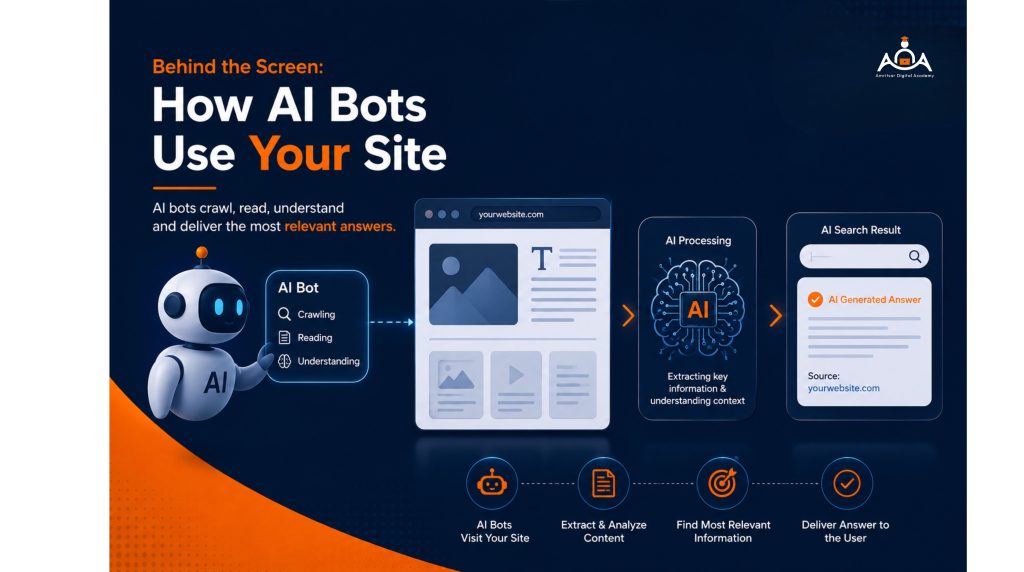
AI has a sophisticated process of web scraping—a method of extracting data from websites with the goal of gathering the most relevant information. In simple terms, AI search tools send out their bots over the internet to scour forums, Wikipedia, and blogs and present a selective curation to answer the user’s query. Often citing the source if the subject is complex. In a way, AI search tools are strolling the same avenues we used to frequent. You can say they are just “googling” the answer for you.
Now, you might be bulging your eyes looking at your Google Analytics, wondering when the last time a real human visited your site was. Here’s the deal: the bots that AI search tools send out are like Casper the Friendly Ghost. They are not visible in traditional traffic metrics, but they are there, reading your data and having conversations with your cat (you are bulging your eyes again, Sir).
We are no longer building sites purely for the human user experience; we are building them for AI bots. If your site’s intent is not clear, precise, and easy to access, you are going to be left behind.
Controlling the Narrative: Why Digital Presence Still Matters
Now that we know AI takes its information directly from websites, what does that mean for the visibility of the individual behind the website? Especially if that person is not selling a product or a service.
Here is why the “websites are dead” logic doesn’t hold up: even in this AI search era where AI has become the middleman, your website is the only place where you get to tell your own story.
You don’t want Casper the ghost bots to go to your neighbour’s site and put words in the AI’s mouth about you. Imagine an AI falsely revealing to the world that you have seven toes on your left foot when we all know you only have six! It is no longer just about being on top of Google Search; it is about making your website AI-friendly. You have to leave out enough digital snacks for AI Santa to come visit when the bell rings true.
Flipping the script: From blocking bots to welcoming them
For the past few decades, website developers have put up massive walls to keep out bots. You see them as the little boxes that ask for a tick or the puzzles where you have to click on all the traffic cones and crosswalks. The sole purpose of these CAPTCHAs was to verify that you are a human (regardless of how many toes you have) and not a zombie bot here to harm the interwebs.
The emergence of AI has flipped this pancake completely on its head. If you are not standing in line with a plate; if you are not visible to the AI, you are invisible to the humans it is serving.
4 steps for building a visible website in the AI search era
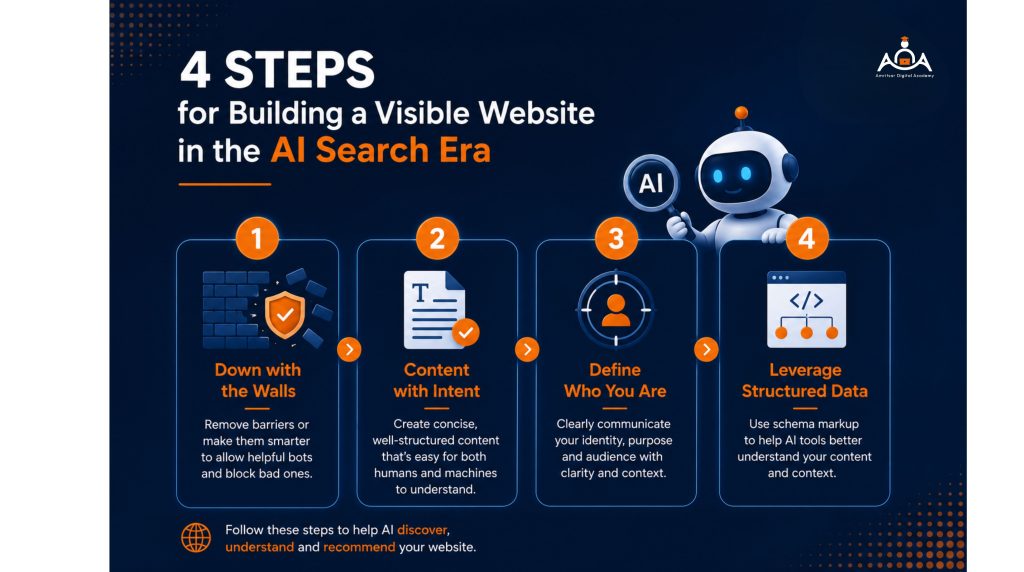
1. Down with the Walls: It is no longer feasible to stand atop the barriers, look at the army of bots, mutter “Winter is coming,” and go back to sleep. Some of these barriers need to come down, or at least be made smarter, so they can recognize the difference between a malicious zombie bot and a helpful chatbot.
2. Content with Intent: Your content needs to be concise and readable. The structure has to make sense to a machine reading it. Now would be the time to dust off the old grammar book and stop tossing semicolons around like Oprah Winfrey tosses out free gifts.
3. Define Who You Are: Developers and creators need to clearly communicate who they are, what they’re about, and who they serve. Whether you are Team Daenerys or Team Stark, if the information is important to your identity, it needs to be clearly presented.
4. Leverage Structured Data: Our old SEO friend, schema markup, is more relevant than ever in the AI age. Just like it did for traditional Google algorithms, structured data helps AI chat tools understand the context of your site at a much deeper level.
Conclusion: Moving with the changing winds of tech
Each new technological development brings its own set of challenges and gatekeepers. Previously, if you were not on the first page of Google, your digital presence was essentially nullified. Now, AI has completely changed the top of the funnel. If the AI cannot easily read and recommend your site, you become invisible.
The wind in the tech world is changing direction, and we must move with it. Those who start implementing these AI-friendly changes today won’t be left behind and will end up way ahead of the curve.
FAQs
1. Will AI overviews completely kill organic traffic to my website?
To put it mildly, no. For simple fast-food queries like “Who won the last FIFA World Cup?” zero searches are a convenient joint. However, for gourmet meals, like guides, tutorials, and
For complicated subjects, websites are still a go-to. If your site features original material, tackling subjects that require a detailed walkthrough, e.g., ‘If life gives you lemons, can you make orange juice?’ you are likely to get more clicks and be cited by AI.
2. Should I block AI crawlers (like ChatGPT’s or Google’s bots) using robots.txt?
Only if you are a corporation protecting intellectual property (IP); an institute protecting customer information; an academy restricting student access to AI; or just a stooge for privacy (no judgment). If you want the internet peeps to come knocking on your door, it is a good idea not to put up barbed wires around the fence. Only by being visible to AI are you going to be visible to the humans AI is serving.
3. Are website developers out of a job because of AI?
Absolutely not. AI can bake cool code without lifting a finger, root out errors like Jesus roots out evil, and generate layouts for a webpage while you sip on your tea. Businesses still need an individual at the helm: workers who make the chocolate out back as they take care of business out front. They need someone to bring together the product and organize and maintain it while they are busy with commerce.
4. If people aren’t clicking through to websites, how will site owners make money?
If I had a nickel for every time this question has been asked, I’d have more money than what I’ve made from clicks on my site. With Google Overview and chatbots hoarding a majority of traffic like goblins, the monetization landscape has changed. Here are a few ways you can take back some of the lost ground:
• Brand visibility: If your audience is not coming to you, you should go where they are. Much like the salesmen/women of yesteryears, go knocking on their social media doors (metaphorically). Create a community around you with direct interactions with individuals interested in buying what you are selling. That way you don’t have to rely on search engines or any moody chatbots and have direct access to your audience.
• Subscription models: Once you have garnered a loyal following, you can charge them for snacks and drinks, i.e., with subscription models, newsletters, and premium content.
• Digital products: AI is limited when it comes to original complex structured content like books, PDF guides, stock photography, and printables. You can sell downloadable content directly to your audience.
• Courses and coaching: After lockdowns in 2020, online coaching classes, courses, and webinars have emerged as a great alternative to traditional face-to-face teaching methods. You can also package your knowledge into a video format and sell it as a digital product.
• Sponsored content: People and companies pay to have their articles, blogs, and reviews hosted. A digital equivalent of putting up a billboard on your website.
5. How do I optimize my website so that AI bots cite it as a source?
Fortunately, you don’t have to go back to school to relearn ranking. A lot of SEO practices are still relevant with the AI search bots:
1. Proper structure: Just like Google, AI is a stickler for proper structuring of content. Structure your page within a sequence of headings (H1, H2s) and bullet points.
2. Use schema markup: Our old friend Schema is still playing the middleman in our dealings with crawlers and bots.
3. Keep your site healthy: AI is a busy entity scouring the net while answering the nagging queries of individuals. If your site blocks bots or has broken links, you are going to be left behind.
4. Maintain freshness: AI prefers scraping fresh content, opening a window for websites with small followings to get cited.