So you have finished your digital marketing course and now its times to face interview room. Most freshers lose in interviews not because they do not know digital marketing but because they did not prepare for digital marketing interview questions for freshers.
Freshers did not know how to answer digital marketing interview questions confidently and clearly.
We have specially written this article for freshers stepping into their first digital marketing job. Whether you are looking for SEO interview questions, social media marketing interview questions, Google Ads interview questions, content marketing interview questions, email marketing interview questions, or PPC interview questions, you will get complete guide in this blog.
What you will learn from this article:
- 40 real digital marketing interview questions for freshers
- Simple, clear, and interview ready expert answers
- Practical tips to prepare for your digital marketing interview
- Interview Preparation Checklist for Digital Marketing
These digital marketing interview questions for freshers are based on real hiring patterns, industry practices, and kind of mock interviews we conduct regularly at Amritsar Digital Academy. So you are not just reading textbook answers, you are getting the real stuff.
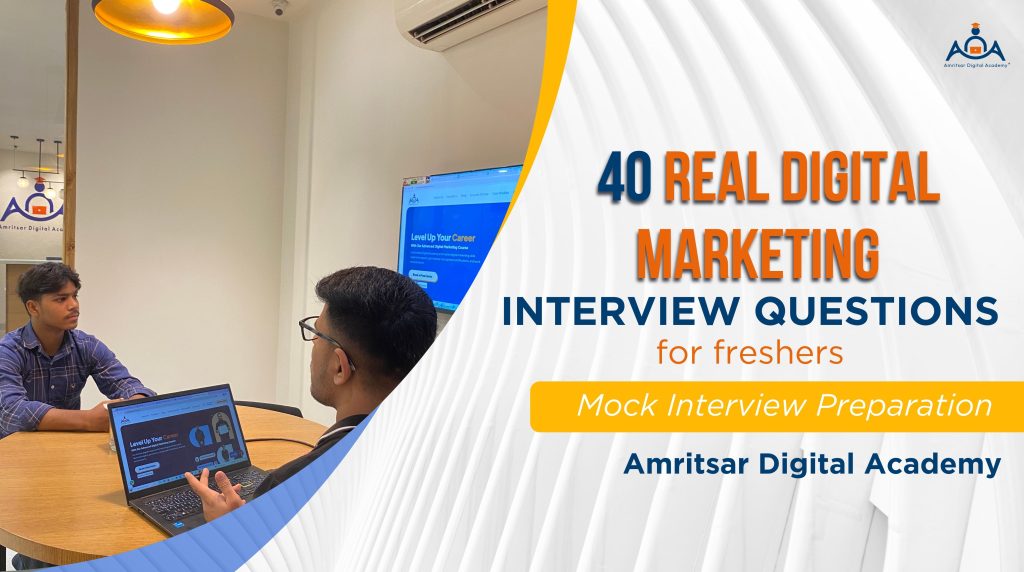
According to research, 860,000 digital marketing job postings are active across India in 2026 and that number is growing every year which means competition is high. So prepare properly for digital marketing interview questions and answers is important.
Let’s get you set for your first digital marketing interview.
Top Digital Marketing interview questions for freshers
Basic Digital Marketing interview questions for freshers
1. What digital marketing is actually and how it is different from traditional marketing?
Sample answer:
Digital marketing is way for promoting products or services through digital channels such as websites, social media platforms, search engines and email.
The main big difference from traditional marketing is that digital marketing lets you target specific audience and track results in real time. Traditional marketing is done by using billboards and TV ads which makes it hard to measure results.
Digital marketing is also much more cost effective especially for small and medium businesses looking to grow.
2. How do you keep yourself updated with latest digital marketing trends?
Sample answer:
- I regularly check Google’s official announcements and take up short courses whenever new updates and tool arrived.
- I follow industry blogs such as Neil Patel blogs, Moz and Search Engine Journal.
- I am also active on LinkedIn and follow digital marketing thought leaders.
3. Which digital marketing channel delivers the fastest results?
Sample answer:
Paid advertising like Google Ads and Meta Ads delivers fast results because ads go live immediately and start getting traffic. Also SEO gives long term results but if we want fast results, I prefer PPC is better option.
4. How does digital marketing funnel work?
Sample answer:
Digital marketing funnel has three stages:
- Awareness: In this stage, you are reaching people who do not know your brand.
- Consideration: This is middle stage where audience is evaluating options.
- Conversion: In last stage, audience is ready to take action.
We use different marketing channels to work better at different stages. Such as social media platforms perform better for awareness and email marketing is for conversions.
5. What are current digital marketing trends in 2026?
Sample answer:
Current digital marketing trends are:
- AI generated content
- Voice search optimization
- Short form video content
- AI search optimisation
- Personalised marketing campaigns
These trends show how brands communicate with their audience.
6. What is conversion rate optimisation?
Sample answer:
Conversion rate optimization means getting more people on your website to do what you want like buy something and sign up. You try different things such as maybe you run A/B tests, changing up your calls to action, and making your pages easier to use. Use tool to see what real people do on your site so you can figure out what works and what needs fixing.
7. Can you explain what landing page is and why it is important?
Sample answer:
Landing page is standalone web page designed for single marketing goal where user lands after clicking ad. Landing page is focused and has clear headline, strong offer, social proof, and call to action. Structured landing page can dramatically improve your campaign’s conversion rate.
SEO interview questions for freshers
8. What role does SEO play in helping businesses grow online?
Sample answer:
Search engine optimization is process of improving website ranking on search engines. It is important because it helps businesses attract users who are actively searching for their products or services.
9. What really matters for ranking on Google in 2026?
Sample answer:
It includes:
- Content quality and relevance.
- E–E–A–T signals
- Page speed and core web vitals
- User experience
- Strong backlinks
- Structured and AI optimized content.
10. What is difference between 301 redirect and 302 redirect?
Sample answer:
| 301 redirect | 302 redirect |
| 301 is permanent redirect. | 302 redirect is temporary. |
| It tells search engines that page has permanently moved to new URL | The original URL is expected to come back. |
| It passes majority of SEO value to new page. | Search engines do not pass same SEO value through 302 redirect. |
11. Compare AEO, GEO, and SEO?
Sample answer:
| Answer Engine Optimisation (AEO) | Generative Engine Optimisation (GEO) | Search Engine Optimisation (SEO) |
| Answer engine optimization is about structuring content so that AI assistants and voice search tools can pull direct answers from it. | Generative engine optimization is focused on making your content appear in AI search responses like ChatGPT, Gemini. | Search engine optimization is improving content to rank higher in search engine results. |
| Users asking questions via voice assistants. | Users interacting with AI chatbots. | Users typing queries into search engines. |
| AEO focuses on structured data, FAQs, conversational tone, and concise answers. | Clear and structured content that AI can parse and cite | It focuses on keywords, backlinks, technical SEO, and on page optimization. |
12. Why E-E-A-T is important for SEO in 2026?
E–E–A–T stands for:
E = Experience
E = Expertise
A = Authoritativeness
T = Trustworthiness
Google uses this framework to check that your content is high quality and credible. E–E–A–T content builds credibility and ensures user trust the information which boosts engagement.
13. How do you optimize for Google’s Search Generative Experience (SGE)?
Sample answer:
To optimize for SGE:
- Write content that directly answers specific questions.
- Use clear headings, schema markup, and FAQ formats.
- Make sure your content is easy for AI to parse
- Provide helpful information and focus on building authority.
Because AI search engine prefers content that is easy to understand and well structured.
14. What are backlinks and why are they important for SEO?
Sample answer:
Backlinks are links from other websites pointing to your site. They act like votes of confidence, it means more quality backlinks you have from relevant and authoritative sites, search engines trust your website more.
Social Media Marketing interview questions
15. How do you create and manage social media content calendar?
Sample answer:
Social media content calendar is schedule of planned posts. To create social media content calendar:
- I started by identifying the platforms, target audience, and business goals.
- Then I plan content categories for which type of content to post.
- Researched trending topics and schedule posts.
- Regularly tracking performance to improve engagement.
16. What kind of content actually performs best on social media in 2026?
Sample answer:
Right now short form videos, authentic storytelling, and content with AI creativity are winning. People want to trust and relate to brands so stuff like community posts, influencer collaborations works well. Do not forget that social platforms act like search engines now so you have to optimize posts for discoverability and AI citations.
17. How do you handle negative comments and feedback on social media?
Sample answer:
I always respond to negative comments calmly and professionally. I acknowledge their concern and thank them for giving feedback. If possible, try to take conversation privately and handle their concern.
When we handled negative feedback properly it show brand’s maturity and build trust with audience.
18. How do you measure engagement rate and what does it actually mean?
Sample answer:
Engagement rate tells you how much your audience interacts with your content. We can figure it out like this: total engagements divided by total followers then multiply by 100. Engagements include things like likes, comments, shares, and saves.
19. What metrics do you track to measure social media engagement?
Sample answer:
Key metrics include:
- Reach
- Impressions
- Engagement rate
- Click through rate
- Follower growth
- Video views
- Share
- Saves
20. How do you stay updated with changes in social media algorithms?
Sample answer:
To stay updated with changes in social media algorithms:
- I follow official platform announcements such as Meta’s business blog, LinkedIn marketing solutions, and YouTube’s creator insider.
- Testing different strategies
- Communities on Reddit and Facebook groups for marketers are also helpful.
21. What are some effective ways to promote event using social media?
Sample answer:
To advertise event on social media:
- I start by defining the audience and choosing right platforms.
- Then I build anticipation with teaser videos, countdowns, and influencer collaborations, while running targeted ads to get registrations.
- Engagement tactics like contests, polls, and branded hashtags help increase reach.
- Then last optimize posts for search and AI visibility and share post event highlights to sustain momentum.
Google Ads interview questions
22. What are Google Ads and how it work?
Sample answer:
Google Ads is paid advertising platform where people show their business ads on search engines, YouTube, Gmail and Google display network. Google ads work on PPC model in which you set budget, choose relevant keywords, write ad copy and pay only when people click on your ad.
Ad placement is determined by your bid and Quality Score.
23. What is Quality Score and how to improve it?
Sample answer:
Quality Score indicates how well your ads connect with your target audience. Google Ads Quality Score helps to evaluate your ad quality. It compares your ad with your competitors who target the same keywords.
Quality Score measures on scale of 1 to 10 and 10 is the highest. Improve Quality Score by improving ad copy, keywords, and landing page that are relevant to users.
24. What is difference between search ads and display ads?
Sample answer:
Search ads show on Google search results page when user type their query on Google search bar.
Display ads show on websites within Google’s display network and are usually visual banner ads.
25. What is good CTR for search ads?
Sample answer:
Good CTR is depend on industry but for many search campaigns, strong CTR is above 4-5%. High CTR means that your ad is relevant to user.
26. How to calculate ROAS?
Sample answer:
ROAS = Revenue from Ads ÷ Cost of Ads
Lets take example:
If you spent ₹10000 on ads and earned ₹40000 in revenue then your ROAS is 400%
27. What are different keyword match types in PPC?
Sample answer:
There are three main match types in Google Ads:
- Broad Match: It shows ads for searches related to keywords.
- Phrase Match: It shows ads when search includes your keyword phrase
- Exact Match: It shows ads only when search exactly matches your keyword.
Also Read: Best Digital Marketing Courses in Amritsar 2026: Guaranteed Job‑Ready Programs
Content marketing interview questions
28. What is content marketing? Why is it important?
Sample answer:
Content marketing is strategy to target audience digitally with relevant and valuable content. It helps to build trust, improve SEO, get organic traffic, and position your brand as authority.
29. How can you create engaging content?
Sample answer:
To create engaging content:
- Start by understand target audience.
- Then create content that genuinely solves user problems.
- Use engaging and visual formats to make content more shareable.
- Always end with clear call to action for viewer.
30. How do you analyse and understand target audience?
Sample answer
I started with checking existing customer data, social media analytics and competitors’ audiences. Also used tools like Meta audience insight and Google Analytics. And also create buyer persona, detailed profiles of who the ideal customer is, what they care about, where they spend time online, and what problems they’re trying to solve.
31. What are keywords and what tools are used in keyword research?
Sample answer:
Keyword research is process of finding right words and phrases that people search for related to your business. Tools used for keyword research are Google Keyword Planner, SEMrush, Ubersuggest and PeopleAlsoAsk.
32. What AI tools you use for content creation?
Sample answer:
There are many different AI tools that we use to create engaging content:
- ChatGPT for content idea generation.
- Canva AI for compelling visuals.
- Jasper for marketing copy.
- Ubersuggest is for keyword research.
But human creativity remains essential for quality content.
33. What is your content ideation process like?
Sample answer:
- I start with keyword research to see what people are searching for.
- Then I look at competitor content to spot gaps.
- I check social media and forums like Quora and Reddit for real questions people ask.
- I also review past content performance to understand what’s worked before.
- Then I build content calendar around topics that align with business goals and audience needs.
34. How do you research your customer persona?
Sample answer:
To research customer persona, focus on quantitative and qualitative research
Quantitative research includes Google Analytics demographics, CRM data, and ad audience insights.
Qualitative research includes customer interviews, social media comments, support tickets, and sales team feedback. These personas help create targeted marketing strategies.
Email Marketing interview questions
35. Explain difference between hard bounce and soft bounce in email marketing?
Sample answer:
Hard bounce in email marketing means that your email is permanently not deliverable due to invalid email address.
Soft bounce temporarily occurs due to inbox full or server down.
36. How to improve open rate of email campaign?
Sample answer:
- Write compelling subject lines
- Segment your list so content is relevant
- Avoid spam trigger words.
- Send it at right time.
- A/B testing subject lines.
37. Explain A/B testing and give example of how you have used it.
Sample answer:
A/B testing is sending two variations of email to different audiences to test which performs better.
For example:
I once tested two subject lines for promotional email:
1st “Get 30% Off Today”
2nd “You are leaving money on the table”.
2nd one had 22% higher open rate so we used that version for full send.
38. Which are the most important metrics to track in Google Analytics?
Sample answer:
- Sessions and Users
- Bounce Rate
- Average Session Duration
- Traffic Sources
- Pages Per Session
- Conversation rate
These are the most important metrics to track in GA4.
39. What do you know about conversion funnel?
Sample answer:
Conversion funnel is step that user takes before arriving on your website such as filling form, click on CTA button. With the help of GA4 you can set up funnel visualization to see where users drop off.
40. Is email marketing still effective?
Sample answer:
Yes. Email marketing is very effective way to connect with audience. This is still one of the most reliable ways to reach people directly. Email marketing is reliable key to stay connected with your customers to retain them like Zomato uses email marketing strategy by sending personalised emails to build long term relation with them.
Digital Marketing Interview Tips For Freshers
Biggest advantage in interview is that if you are fully prepared. Here are some digital marketing interview tips for freshers:
Do Proper Company Research
Before going to interview, you need to spend 30 minutes research on company profile. Check their social media presence, their website and what services they offer. Interviewers like when candidate has done their homework.
Knowledge of Basic Marketing Concepts
Even if you are fresher but you need to clear basic fundamentals of digital marketing such as marketing funnels, KPI, target audiences and ROI.
Prepare Practical Examples
Do not just recite textbook answers. Use examples from your college projects, internships, any freelance gigs you have done. Real life stories show you are not just talking, you have actually done the work.
Know the Tools
Interviewers love to ask about digital marketing tools. Be ready to talk about the ones you have used even if it is just the basics. Get familiar with SEMrush, Google Analytics, and Google Search Console.
Interview Preparation Checklist for Digital Marketing
| ✔️ Learn basic SEO concepts properly. |
| ✔️ Understand social media marketing strategies and their different platforms. |
| ✔️ Learn basics of Google Ads—quality score, ad campaigns, bidding. |
| ✔️ Study content marketing fundamentals like keyword research, personas, content type and target audience. |
| ✔️Learn how Google Analytics works and what metrics are used. |
| ✔️ Spend 30 minutes on company profile research before going to interview. |
| ✔️ Stay updated with latest digital marketing trends. |
So prepare with these structured digital marketing interview questions for freshers that can help you gain confidence and improve chances of getting hired. At Amritsar Digital Academy, our students learn digital marketing through practical training, real projects, and mock interview sessions that prepare them for successful careers in the digital marketing industry.