
Imagine you are going to new city and staying in tree house, mountain cabin or private island instead of hotel. Just 10 years back, this notion seemed unrealistic. But now people are booking these one-of-a-kind stays on Airbnb. They were not like traditional hotel chains, Airbnb provides type of housing supply that never existed in marketplace before such as spare rooms, empty apartments, vacation homes sitting unused for ten months year. It connects people who have space to rent with travelers looking for unique places to stay.
In analysis of latest annual results from Airbnb, we notice that platform generated $12.24 billion of revenue in 2025, hosted 156 million nights and experiences booked, and has presence in 220+ countries and regions. These numbers tell the story of the size of the business that has changed the way people travel and earn income through short-term rentals.
This Airbnb case study is important if you work in marketing, run startup, or study business strategy, because Airbnb’s marketing strategy playbook has shown how Airbnb makes money and how it markets itself.
In this Airbnb case study piece, our experts at Amritsar Digital Academy have used all financial data from Airbnb’s FY2025 annual report, its Q1 2026 earnings release and its SEC filings to write case study on Airbnb.

Table of Contents:
- What is Airbnb?
- Airbnb’s Mission and Vision
- The Airbnb Story
- What Challenges Did Airbnb Face in Its Early Stage?
- Airbnb Business Model Explained
- Airbnb Marketing Strategy: How Airbnb attracts guests and hosts
- What We Can Learn from Airbnb Case Study
- SWOT Analysis of Airbnb
Airbnb Case Study at a Glance
| Metric | Details |
| Founded | 2008 |
| Founders | Brian Chesky, Joe Gebbia, Nathan Blecharczyk |
| Headquarters | San Francisco, California, USA |
| Industry | Online travel and hospitality marketplace |
| Countries Served | 220+ |
| Hosts | 5.5 million+ |
| Guests | 2.5 billion+ (all-time) |
| Listings | 9 million+ |
| Revenue (FY2025) | $12.24 billion |
| Net Income (FY2025) | $2.51 billion |
What is Airbnb?
Airbnb is not hotel. It is a different style of travel marketplace that allows people to rent out their space to travelers who are looking for place to stay. It includes hosts and guests.
- Host: People who have space to rent. They list their space such as apartments, villas, farmhouses, treehouses, cabins, and even castles on the platform.
- Guests: Travelers who want to look for accommodation can browse for these properties, check prices, view real guest reviews and make bookings directly through Airbnb.
Airbnb makes money by charging service fees on successful bookings. This will be beneficial for both hosts and guests. They differentiate themselves by offering unique accommodations such as local experiences and personalized stays that hotels cannot replicate.
Airbnb’s Mission and Vision
Mission:
| Airbnb’s mission is ‘to help create a world where you can belong anywhere and where people can live in a place, instead of just traveling to it.’ |
Vision:
| Airbnb’s vision is ‘to create a world where anyone can belong anywhere, providing a platform that connects people through unique travel experiences and fosters a sense of community.’ |
Who uses Airbnb?
To make true marketplace, Airbnb is used by multiple customer groups.
| Leisure Travelers | Families, couples, and solo travelers are looking for affordable and unique accommodation. |
| Business Travelers | Professionals who want comfortable homes with kitchens, workspaces, and longer stays. |
| Digital Nomads | Remote workers who stay in different cities for weeks and months while working online. |
| Families | Parents choose Airbnb because larger properties offer more space and kitchen facilities compared to hotel rooms. |
| Hosts | Individuals who rent spare rooms, apartments, vacation homes, or entire properties to generate additional income. |
| Professional Property Managers | Many hospitality businesses now use Airbnb to manage multiple listings across different cities. |
The Airbnb Story

Mostly successful companies start with extraordinary products, but Airbnb starts with financial problems. In 2007, Brian Chesky and Joe Gebbia struggled to pay rent in San Francisco. At the same time, major design conference had filled local hotels, leaving many visitors without accommodation. Then founder saw opportunity and tried one experiment. They bought three air mattresses, offered breakfast to guests, and invited conference attendees to stay in their apartment. This idea worked and then this experiment became “AirBed & Breakfast.”
This idea solved an immediate problem but it also revealed something much bigger:
People were willing to stay in someone else’s home if experience felt trustworthy and affordable. Airbnb works because they tested real market problem before scaling their business.
What Challenges Did Airbnb Face in Its Early Stage?
Airbnb faced many challenges in its early stage. Here are some of biggest obstacles:
- In its starting period, there were very few hosts who listed their space on platform.
- Most of the people were not aware of what Airbnb is and what they provide to travelers.
- People have doubted strangers so these trust issues became biggest challenge to scaling Airbnb.
- In early stage, revenue was very low and at one point, founders decided to shut down the company.
Airbnb-Key Milestones
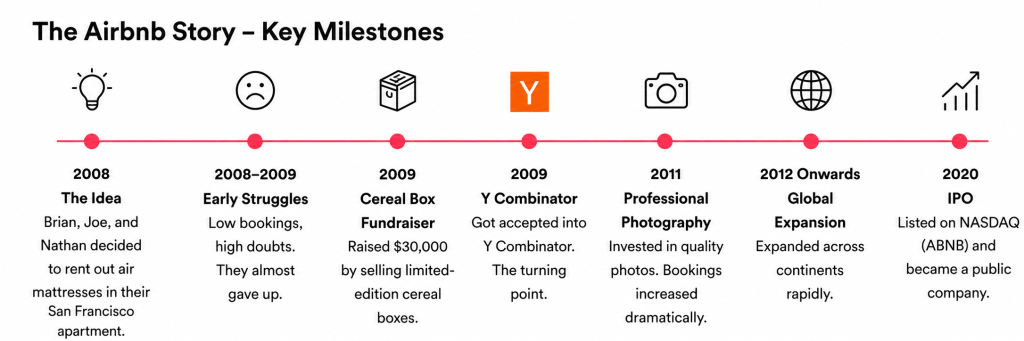
- In 2008, Brian Chesky, Joe Gebbia, and Nathan Blecharczyk rented out air mattresses in their San Francisco apartment to earn extra money.
- From 2008–2009, they faced low bookings and decided to wind up the project.
- In 2009, they raised $30,000 by selling limited edition cereal boxes themed around the U.S. election.
- Again in 2009, Airbnb was accepted into Y Combinator startup accelerator which was major turning point for growth.
- In 2011, invested in high quality property photos which dramatically increased bookings.
- In 2012, rapidly expanded operations across continents, scaling into worldwide platform.
- In 2020, they listed on NASDAQ under ticker ABNB officially becoming public company.
What Problem Did Airbnb Solve?
Airbnb did not succeed just because of new booking platform. The company became successful because it addressed problems that travelers and property owners faced.
| Challenges for Travelers | Challenges for Property Owners |
| 1. High Hotel Rates: Before Airbnb, hotel prices were high during holidays, festivals, and peak season. So Airbnb address this issue that families want less expense on accommodations during travel. | 1. Empty Rooms Generated No Income: Millions of homes worldwide have extra bedrooms that remain unused for many years. Airbnb offer opportunity to homeowners to rent their space and earn income. |
| 2. Limited Availability: In major events and holiday seasons, mostly all hotels are pre booked. Then company solved this issue by allowing local residents to rent out their space. | 2. Traditional Rental Method: With traditional rental method, owners required brokers and budget for marketing to find paying guests. Airbnb simplified this process by offering verified guest profiles and secure online payments without spending on marketing. |
| 3. Lack of Local Experiences: Many travellers want to experience local culture that traditional hotels can not provide. | 3. High Transaction Friction: Short term rental involved manual process such as paperwork, cash payments, and price negotiation. But Airbnb ditialized entire booking journey. |
Airbnb Business Model Explained
Through this Airbnb case study, let’s analyze Airbnb’s business model and learn how Airbnb makes money.
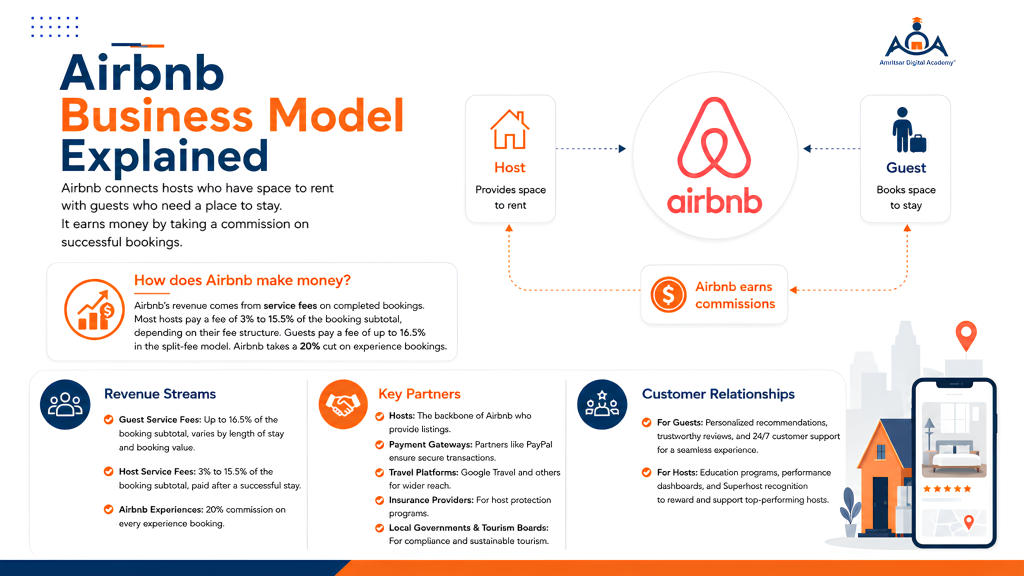
Two-sided marketplace model
Airbnb works on two sided marketplace model, one is host and second is guest. Hosts provide space to rent to guest who need space to stay. On successful booking on platform, Airbnb earns commissions. This is the main pillar of Airbnb business model that makes company scale to 8 million listings without ever owning single one of them.
| How does Airbnb make money?Airbnb’s revenue comes from service fees on completed bookings. Most hosts pay fee of 3% to 15.5% of the booking subtotal, depending on their fee structure. Guests pay fee of up to 16.5% in the split-fee model. Airbnb will take 20% cut on experience bookings. |
- Guest Service Fees: The main source of income for Airbnb is when guests book stays on Airbnb, they pay service fee on top of listing price, up to 16.5% of total booking. This percentage changes on basis of length of stay and booking total value.
- Host Service Fees: Hosts also pay service fees to Airbnb. This is another source of income from Airbnb. When guest completes their stay, 3% of service fee of booking subtotal is paid.
- Airbnb Experiences: Apart from accommodation, they offers Airbnb Experiences to travelers who want to experience local culture, activities and tours. It takes 20% commission on every Airbnb Experience booking.
Key Partners of Airbnb
Airbnb does not operate solely. Their key partners include:
- Hosts are main backbone of the platform who provide listings.
- For secure payment transactions, payment gateways such as PayPal have partnered with Airbnb.
- Travel platforms for wider distribution such as Google Travel.
- Partnered with insurance providers for hosts protection programs.
- Local government and tourism boards for regulatory compliance and sustainable tourism.
Customer Relationships
Airbnb maintains strong relationships with guests through personalized recommendations, robust review system and 24/7 customer support. When you travel more on Airbnb, they understand your taste and preferences then they recommend stays that match your taste.
With hosts, they built relationships through host education program, performance dashboard and Superhost recognition, status award for top performing hosts who get more bookings and increase credibility of platform.
Airbnb Marketing Strategy: How Airbnb attracts guests and hosts
Airbnb marketing strategy is main powerful pillar of its global success. Other travel companies focus on promoting hotel rooms, their discounts but Airbnb marketing strategy works on different approach. Their marketing philosophy combines brand storytelling, user generated content, performance marketing and referrals. In this Airbnb case study, lets decode what type of digital marketing strategy Airbnb used.
Airbnb’s Brand Positioning Strategy
In early stage, Airbnb focused on affordable accommodations. In 2014, they repositioned themselves from accommodation platform to travel experience brand. Airbnb marketing always highlights local experiences, human connection between host and guest, authentic travel, and sense of community and cultural immersion.
As platform grew, company developed the concept of ‘Belong Anywhere’ to inspire travelers to live like local, not tourists, in the destination.
Airbnb SEO Strategy
Airbnb does not need to publish thousands of blog posts to rank on Google. Every listing, every city page, and every neighborhood page is piece of SEO content generated automatically as hosts and guests use the platform.
- Natural use of long tail keyword strategy such as ‘luxury villas in Bali’ and ‘treehouses in Kerala, converts at much higher rate than broad terms because person searching already knows exactly what they want.
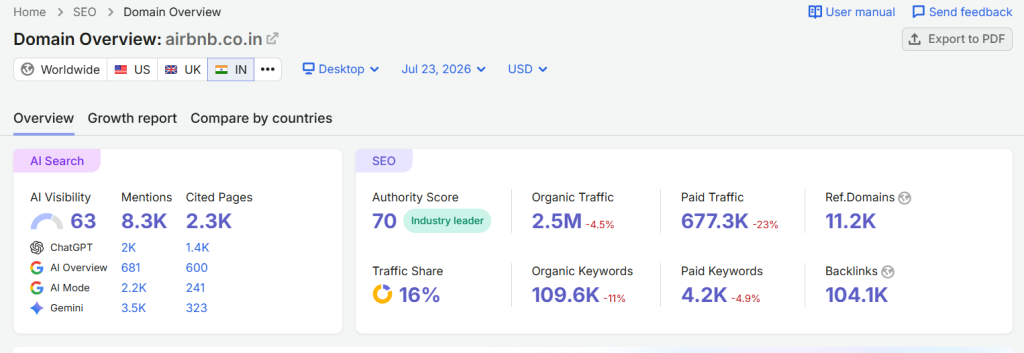
- Airbnb website gets 2.5M organic traffic with industry leading domain authority of 70.
- Airbnb is proof that well structured marketplace can generate massive organic traffic with programmatic landing pages.
Content Marketing Strategy of Airbnb
Airbnb content marketing strategy focuses on building customer trust through user generated content and hyper local experiences. They were not creating content to sell only bookings, main aim is to create trust within its community.
- User-generated content: Airbnb uses real experiences of guests, their stories rather than making polished ads. This strategy helps to create strong trust between guests and hosts.
- Travel guides: It provides neighborhood recommendations, destination inspiration, and seasonal travel ideas to help undecided travelers choose destination before they start booking.
- Host education: It includes help center, photography guidance and pricing tools that helps hosts list and price properties properly and directly improve quality of supply on the platform.
- Community stories: By sharing real guest experiences and host success stories, do more for trust than any ad can do.
Referral Marketing Strategy of Airbnb
Airbnb customer acquisition strategy works very well. Because its referral program rewards both existing user who invites someone and new user who joins.
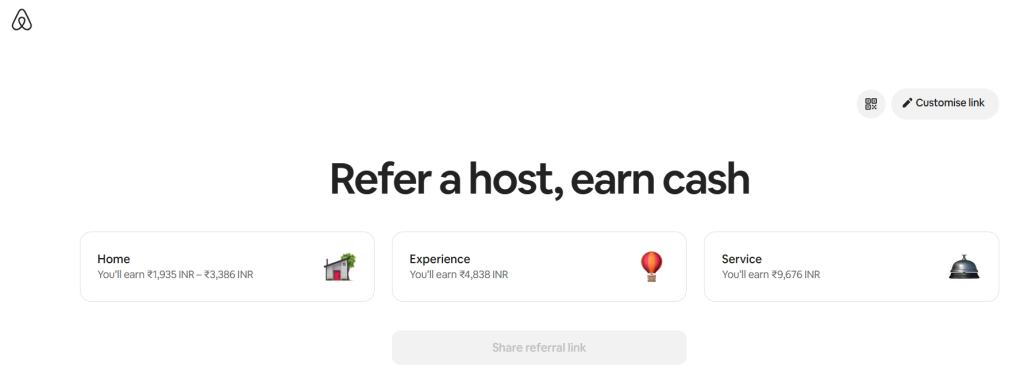
How it works:
- Existing user invites friend and refers Airbnb.
- Friend books their first stay on Airbnb.
- Then both the new and old user receive reward from Airbnb.
That referral marketing strategy of Airbnb acquires new users and retains old users.
Social Media Strategy of Airbnb
Airbnb social media marketing strategy runs on different playbook on each platform rather than repeating the same content everywhere.
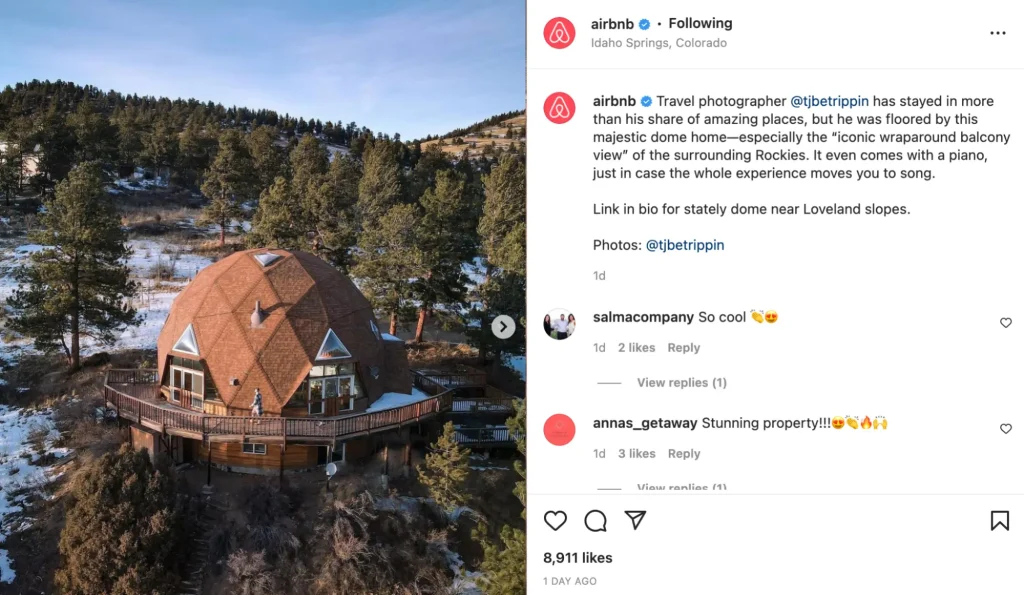
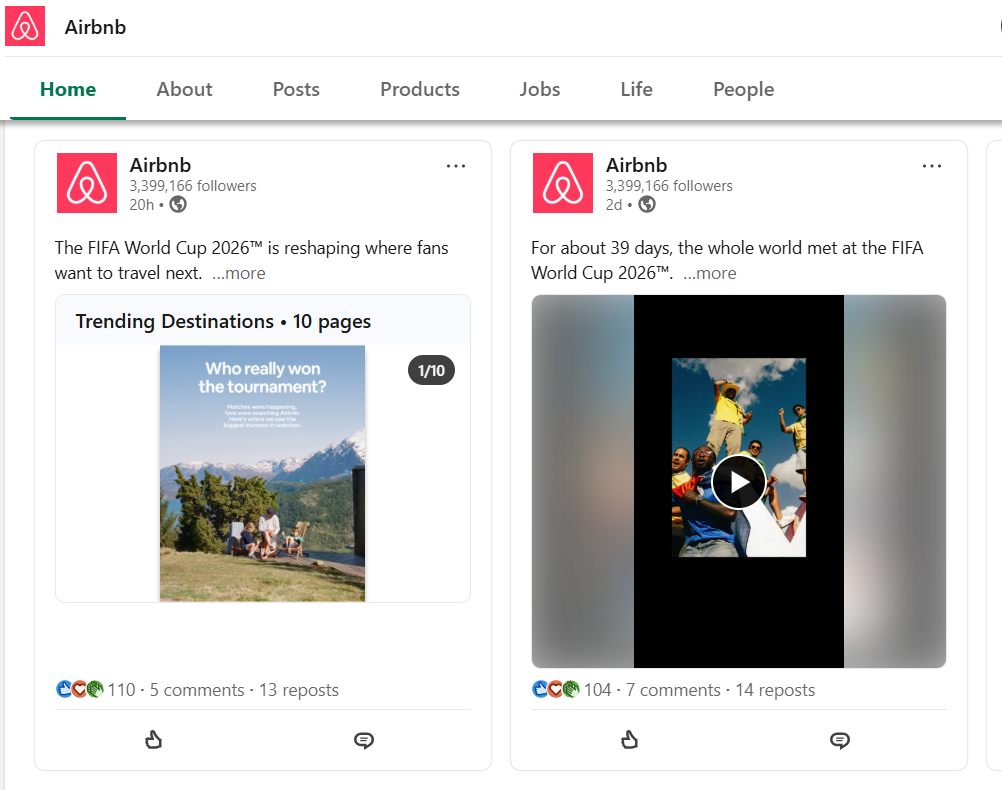
| Platform | Primary goal | Content type |
| Airbnb showcases experiences that encourage people to imagine their next trip. | Visual storytelling, destination photography, Reels | |
| TikTok | To connect with younger travelers through short form content. | Community content and short form travel trend content |
| To highlight Airbnb’s corporate identity. | Corporate announcements and employer branding | |
| YouTube | Need to strengthen emotional connections with brand while showing Airbnb’s values. | Hosts stories, brand campaigns, travel documentaries, guest experiences |
| To help in trip planning | Destination boards and travel collections |
Email and Push Notification Marketing Strategy of Airbnb
Email marketing is one of the most effective customer retention channels for Airbnb. They did not send promotional emails to its users, Airbnb personalizes communication based on user behavior. By sending personalized notifications, it helps users stay connected. For example:
Examples include:
- Price drops
- Booking confirmations
- Wishlist reminders
- Check-in alerts
- Travel updates

Airbnb email and push notification strategy is act as booking tool. It is continuous relationship platform, engaging users before, during and after every trip with personalized communication and useful travel features.
What We Can Learn from Airbnb Case Study
With this Airbnb case study, it offers valuable lessons for businesses of every size.
- Company focuses on solving actual customer problems before spending heavily to scale business.
- Treat trust as main product feature instead of spreading marketing messages.
- Airbnb focus on customer experience rather than competing with price only.
- Use technology and personalization to make every customer interaction more relevant.
- Created perfect combination of brand building with performance marketing for sustainable growth.
SWOT Analysis of Airbnb
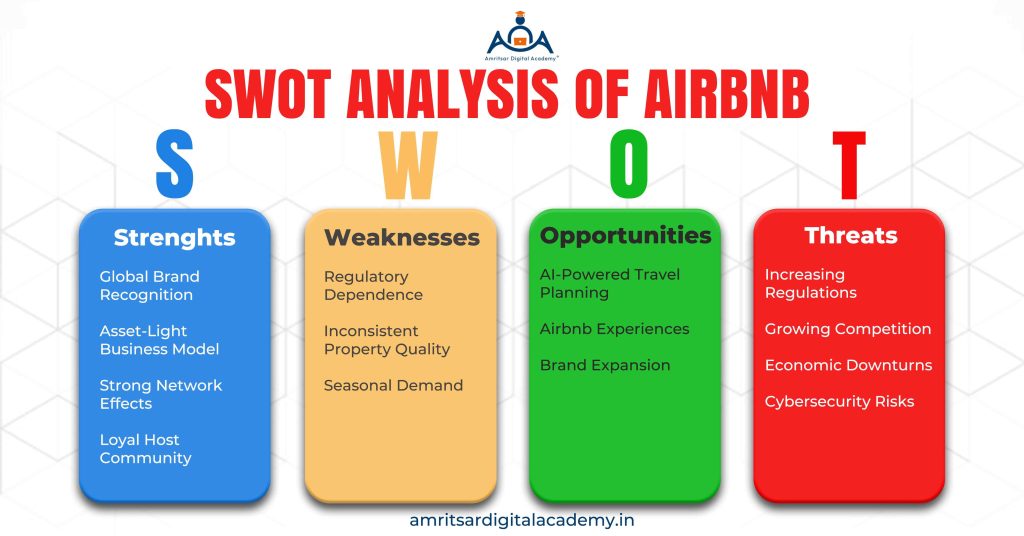
S = STRENGTHS
W = WEAKNESSES
O = OPPORTUNITIES
T = THREATS
STRENGTHS
- Global Brand Recognition: Airbnb is global travel brand now. For many travelers, Airbnb is the first priority when booking unique accommodations. With positive customer experiences, word of mouth recommendations make this advantage for Airbnb that competitors cannot copy easily.
- Strong Network Effects: Airbnb has strong network effects. With every new hosts increase more choices of accommodations for guests. More choices mean more travelers, more travelers mean more reviews and more reviews increase trust. This chain continuously makes Airbnb’s marketplace strong.
- Loyal Host Community: Many hosts depend on Airbnb to generate their primary income. They invested years to maintain their reputation and positive customer reviews.
- Asset-Light Business Model: Like other hotels, Airbnb does not own its inventory and this is the biggest advantage to the company. Without spending on inventory they generate revenue by providing technology and infrastructure that connect hosts with guests.
WEAKNESSES
- Regulatory Dependence: Airbnb operates in different cities with different laws. It becomes difficult for them to adapt to changing regulations because it can reduce listing availability and affect revenue in key markets.
- Inconsistent Property Quality: There are different hosts with different property qualities in which guest may encounter differences in cleanliness, amenities and maintenance. This becomes operational challenge for Airbnb marketplace.
- Seasonal Demand: People never travel all year. Travel demand is high in peak seasons but in off season, this reduces revenue.
OPPORTUNITIES
- AI-Powered Travel Planning: Airbnb can integrate with AI to transform how travelers discover destinations and plan trips. With the help of AI, it can increase booking conversions and improve customer satisfaction.
- Airbnb Experiences: Travelers want more than place to sleep. They want memorable local activities. Expanding experiences can help diversify Airbnb’s revenue streams and make its overall travel ecosystem more resilient.
- Brand Expansion: Airbnb has growth potential with increase of host participation and travel demand, it will become long term opportunities.
THREATS
- Increasing Regulations: Governments are starting to tighten rules for short term rentals to solve housing shortages and community concerns. These restrictions can reduce listing availability in important destinations.
- Growing Competition: Airbnb is not only one booking platform for accommodations. Competition is very high in travel marketplace, Airbnb needs to competes with Expedia, traditional hotel chains and regional vacation rental platforms to stay on top in travel marketplace.
- Economic Downturns: In period of recession, people avoid extra expenses on travel which declines revenue of Airbnb.
- Cybersecurity Risks: Airbnb is digital platform, so handling lots of user data and digital payments requires continuously investing in cybersecurity.
Final Verdict
Airbnb journey is more than successful startup journey. Airbnb case study shows how one simple idea can transform travel industry. The company consistently challenged traditional assumptions of hospitality. Its success is not only based on spending heavy budget on marketing of Airbnb. They mainly focus on:
- Solving real customer problems
- Creating meaningful experiences
- Empowering hosts
- Creating a powerful platform where successful bookings make the business stronger.
For students, marketers, and entrepreneurs, this Airbnb case study gives powerful reminder:
| Sustainable growth comes from creating value for every participant in your ecosystem, not just your customers. |
Want to build growth strategies like Airbnb’s for your own brand? Explore our advanced digital marketing course to learn the SEO, branding, and marketplace growth tactics behind case studies like this one.
Sources:
Airbnb Newsroom – About Airbnb (company profile, hosts, listings, guest arrivals)
Airbnb FY2025 Annual Report (Form 10-K) (revenue, net income, headquarters, business overview)
Related Case Studies You May Like: