Maggi case study shows how popular brand faces crisis and comes back with consumer communication, emotional marketing strategies, and well planned relaunch. In June 2015, Central Government of India put a ban on the sale of Maggi in India because of certain food safety problems related to lead levels and labelling of the product. This controversy had a negative impact on the minds of the consumers and Maggi was removed from the various shelves of shops in India for a number of months.
Then in November 2015, Maggi strategically came back into the market and rebuilt its position with strategic planning of social media conversations, emotional storytelling, promotional campaigns and online partnerships to reconnect with customers.
This Maggi case study explains why Maggi was banned, how they rebuilt their position, and what marketing strategies they used to return to the market.
Table of Contents
- Maggi Brand Overview
- Maggi Target Audience and Brand Positioning
- What Happened to Maggi in 2015?
- How Did Maggi Make Comeback After 2015 Ban?
- What Was Maggi’s Marketing Strategy Behind Its Successful Comeback?
- Maggi Digital Marketing Strategies
- Marketing Mix of Maggi: 4Ps Analysis of Maggi
- Maggi SWOT Analysis
- What Can Businesses Learn from Maggi’s Marketing Strategy?
Maggi Brand Overview: How Did Maggi Become Popular In India?
Maggi is not just normal noodle product. Everyone knows Maggi is one of the most recognisable noodle products in India when someone talks about 2-minute noodles.
History of Maggi in India
When Nestle India launched Maggi in India in 1983, the idea of instant noodles was new for many Indian households. But Nestlé pitched one simple promise to Indian families i.e instant 2 minute hot meal ready. Within number of years, Maggi and 2-minute noodles meant same thing to people.
Maggi contributed roughly 30% of sales to Nestle India. That is why the ban on Maggi hurts Nestle India so much.
Maggi Target Audience and Brand Positioning
Maggi targets different groups of audiences and each audience has their own reason to buy Maggi. Let’s understand Maggi’s target audience through this Maggi case study:
| Target Audience | Consumer Preference |
| Children and teenagers | Who wants quick, affordable and easy to cook meal. |
| College students | Who wants convenient option and lives away from home |
| Working professionals | Without spending too much time on cooking due to busy schedule. |
| Families | Parents who want light meal and quick snack before meal. |
Maggi Brand Positioning:
Maggi Brand position in the industry is defined by its image as reliable provider of good tastes and convenience it brings to people and their food experiences.
Some important factors making the brand position effective are:
- Convenience: Maggi is famous for slogan of 2 minute noodles which represents the simplicity of the cooking process and its speed.
- Taste: The product is associated with delicious recipes and tastes.
- Affordability: Its price range is set in way that makes it available for everyone.
- Emotional connection: Maggi is linked with happy memories of childhood.
- Faith and reliability: The brand benefits from Nestle reputation and experience.
What Happened to Maggi in 2015?
In 2015, there were concerns raised about the presence of lead in Maggi noodles after laboratory tests were conducted. There were also concerns surrounding claims regarding the absence of the additive MSG from the product. All this gained substantial media coverage and created confusion amongst buyers.
What triggered Maggi controversy?
Maggi controversy started when food safety authorities received laboratory reports about Maggi noodles. Two main issues came into notice:
- Lead content: One of the governmental laboratories stated that the concentration of lead is higher than the regulation sets forth.
- Regarding MSG labelling: Questions appeared because MSG was detected in product mentioned to be “no added MSG”.
Nestle India assured that no MSG was included in their Maggi noodles, nevertheless, the confusion continued to snowball and more and more authorities and laboratories examined Maggi samples. Negative image had an impact on consumers and the company had to deal with pressuring issue.
Why was Maggi banned in India?
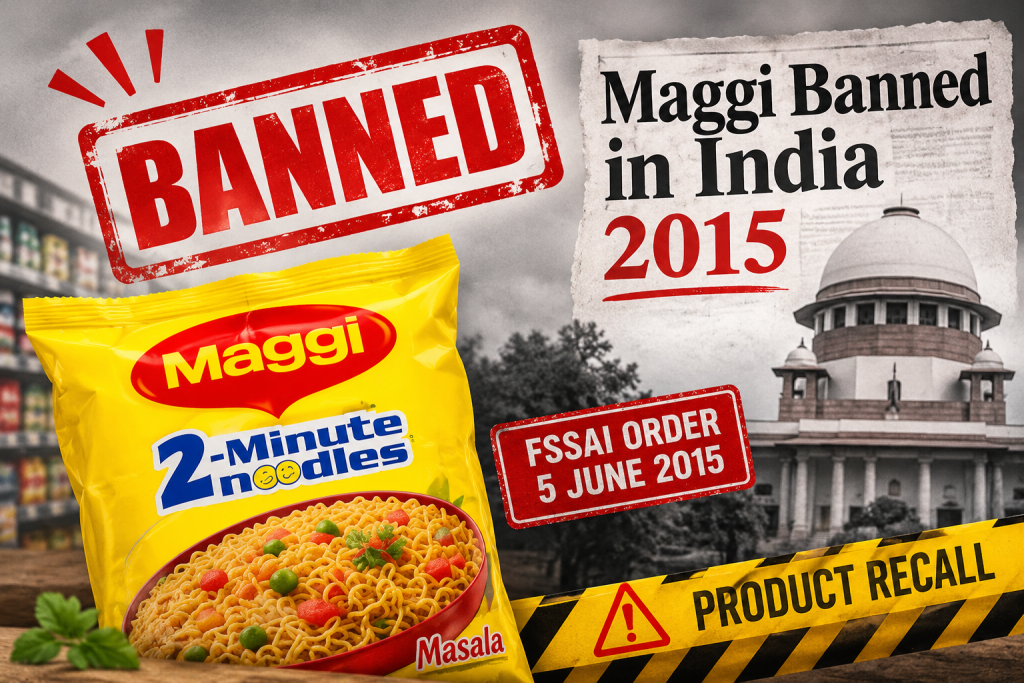
Everyone wants to know why Maggi was banned in India. This is one of the most viral food safety controversies. On 5 June 2015, FSSAI issued order to Nestle India to:
- Recall all nine variants of Maggi noodles from market.
- Stop production and sale of Maggi noodles.
- Withdraw claim of ‘No ADDED MSG’ from product packaging.
Then Nestle India announced that they would temporarily stop selling Maggi noodles amid the growing controversy. The company immediately approached the Bombay High Court challenging the regulatory orders.
On 13 August 2015, the Bombay High Court rejected the ban orders for lack of transparency and violation of principles of natural justice. The court stated that Maggi could only resume sales after fresh tests were conducted in accredited laboratories.
This still did not amount to saying that all previous allegations related to food safety were untrue. The requirement of fresh testing was deemed to be an important prerequisite for the relaunch of the product.
Timeline of Maggi Ban and Comeback
| Date | Important Development |
| April 2015 | Food safety testing concerns gain public attention |
| 4th June 2015 | Tamil Nadu Government banned Maggi |
| 5th June 2015 | FSSAI issued order to Nestle India to recall all nine variants of Maggi and stop production and sale of product.Andhra Pradesh Government |
| 6th June 2015 | Central Government of India banned nationwide sale of Maggi |
| 13th August 2015 | Bombay High Court rejected the ban orders for lack of transparency and violation of principles of natural justice. |
| 16th October 2015 | According to Nestlé three accredited laboratories conducted tests, and the results showed that the tested food items containing Maggi were within the allowed lead limits. |
| 4th November 2015 | Nestle confirmed that the newly arrived food products received clean chit from all three required laboratories. |
| 9th November 2015 | The famous Maggi noodles have made their comeback in India. |
How Did Maggi Come Back After 2015 Ban?
Maggi came back to market with careful planning because brand needs to restore consumers trust and rebuild its position. So let’s understand how did Maggi came back with strategic planning:
Rebuilding Consumer Confidence Through Communication
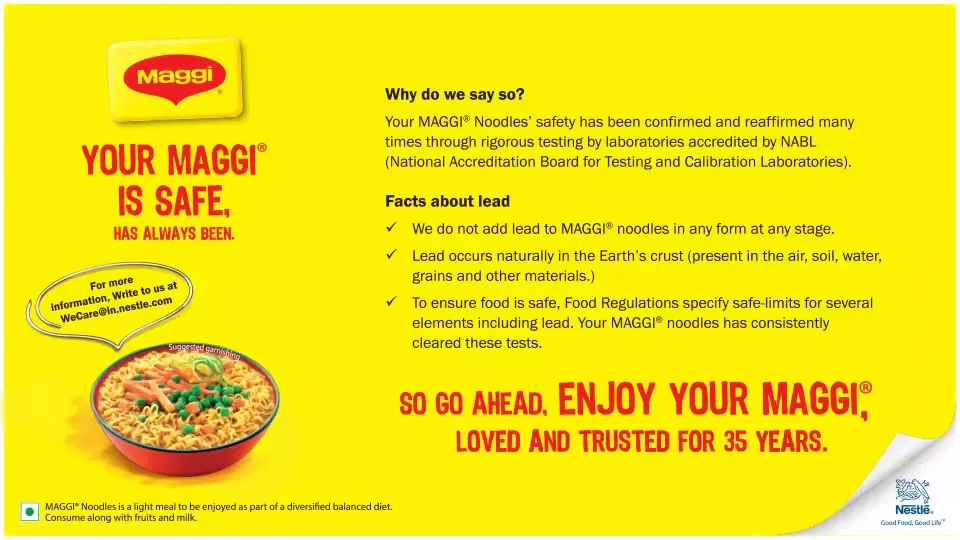
The biggest challenge Maggi faced is to restore consumers trust and address questions on product safety. So company informed people about the progress of the testing process and the actions that need to be undertaken before Maggi can go back to the market. They also introduced communication campaign, “MAGGI Is Safe, Has Always Been” which plays very important role in relaunch of Maggi.
Using Emotional Connection
Nestle did not attempt to win customers solely through lab reports. Instead, they relied on their 32 years of familiarity. Their #WeMissYouToo campaign captured the small moments they left behind such as the university snack, late night munchies, and mothers’ quick fix. They encouraged customers to feel that Maggi missed them as much as they were missing it.
Relaunching Maggi Through Online and Offline Channels
After completing all required testing processes, Maggi relaunched in the market on 9th November 2015. Nestle entered into an agreement with Snapdeal for an exclusive online relaunch via special kits named Maggi Welcome Kits.
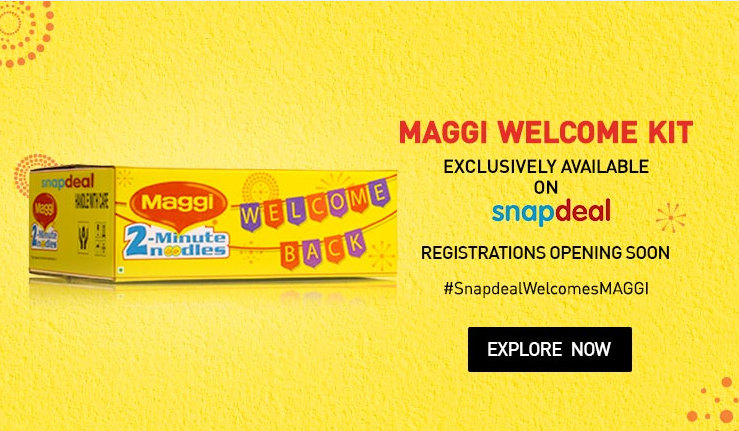
These kits contained:
- 12 packs of Maggi noodles.
- A calendar of Maggi for the year 2016.
- A fridge magnet of Maggi.
- Postcards of Maggi.
- A letter of welcome.
As per the 2015 annual report of Nestle India, total of 60,000 welcome kits were sold via Snapdeal and within 5 minutes, the kits were sold completely. It was estimated that around 10 lakh users pre-booked for the kits.
The same annual report data reported that Maggi regained its market share of 0% from 9th November to 33.3% on 31st December 2015. These figures show the initial response from the consumers after the relaunch.
What Was Maggi’s Marketing Strategy Behind Its Successful Comeback?
Maggi’s comeback strategy is combination of emotional marketing, social media marketing, promotional campaigns and strong retail distribution channel to rebuild customer trust. Let’s decode Maggi marketing strategies through this Maggi case study:
1. Emotional Marketing Strategy and Nostalgia
Maggi is not just noodles, it is available in every home grocery list. Brand builds emotional connections with consumers for decades. This relationship helps Maggi to come back and reconnect with customers after ban. In every home, Maggi is the easiest available option for light snack meal. Consumers emotionally connect with Maggi with school days, hostel life, travelling with friends and easy to cook meal options.
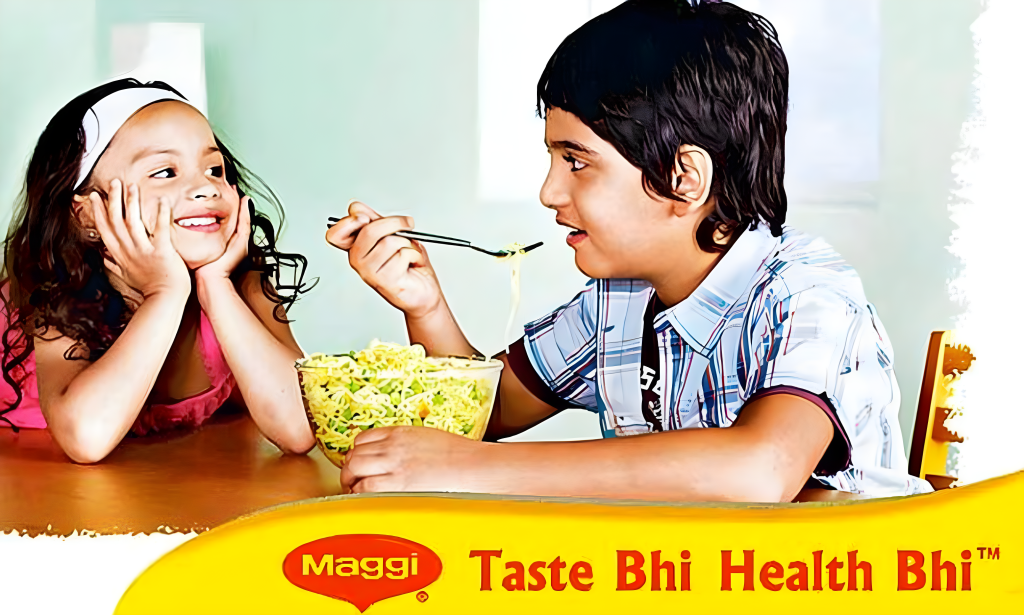
So emotional marketing strategy helps Maggi to reconnect with existing customers who already like Maggi.
2. Trust Building and Reputation Management
After such big controversy in 2015, it’s very difficult to win back customers trust. So Nestle India decided to communicate with consumers with fresh lab test reports and launch campaign ‘MAGGI Is Safe, Has Always Been’.
Also the company met the testing requirements mandated by the Bombay High Court before being permitted to return to the market.
This strategy indicates that cultivating and preserving good reputation necessitates transparent information backed up with proven deeds.
A firm should not hope to have its customer base trust it merely due to the introduction of new advertising campaign.
3. Strategic Product Relaunch and Promotions
Maggi’s product relaunch was an opportunity to leverage consumer anticipation to generate sales. The alliance with Snapdeal helped the brand get media attention via exclusive welcome kits as well as flash sale. The unique packaging helped to transform the relaunch into a big event as opposed to a typical product release.
The report of the sale of 60,000 welcome kits in five minutes also resulted in additional media attention. This promotional approach helped the brand establish initial demand and generate buzz.
4. Omnichannel Marketing Approach
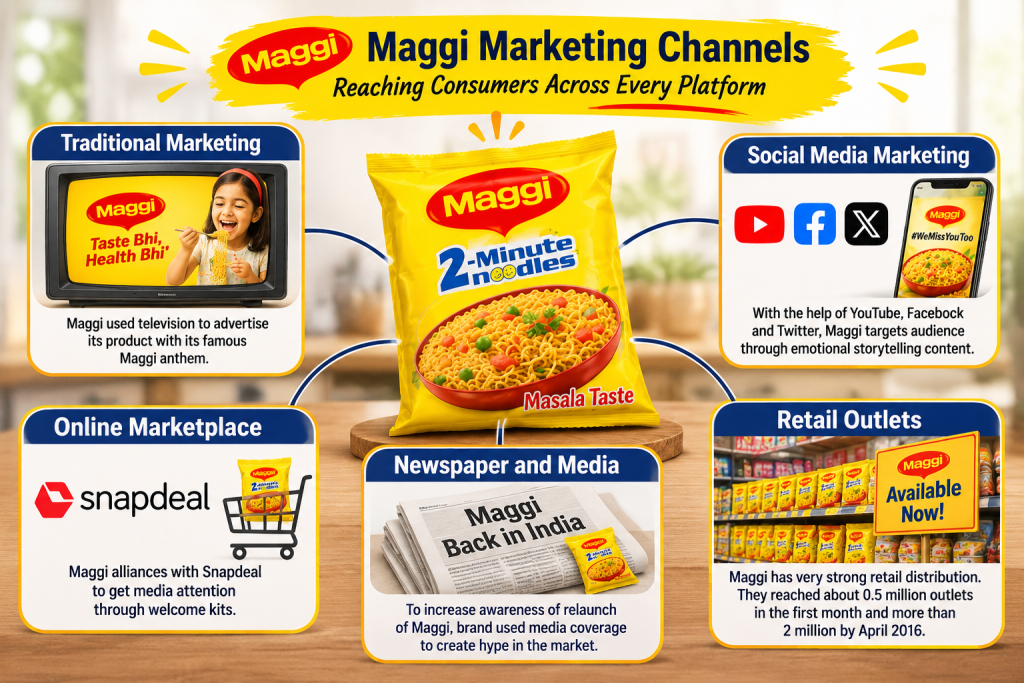
Maggi used both online and offline marketing channels to reach their target audience. Maggi targets every marketing channel where their customer spends time. Here are Maggi marketing channels:
| Maggi Marketing Channel | Role |
| Traditional marketing | Maggi used television to advertise their product with its famous Maggi anthem. |
| Social media marketing | With the help of YouTube, Facebook and Twitter, Maggi targets audience through emotional storytelling content. |
| Online marketplace | Maggi alliances with Snapdeal to get media attention through welcome kits. |
| Newspaper and media | To increase awareness of relaunch of Maggi, brand used media coverage to create hype in the market. |
| Retail outlets | Maggi has very strong retail distribution. They reached about 0.5 million outlets in the first month and more than 2 million by April 2016. |
Maggi Digital Marketing Strategies
Maggi digital marketing strategies have played very important role in bringing Maggi back to the market.
Social media marketing strategies of Maggi
Nestle analysed online conversations in order to know the type of things people were saying about Maggi. The brand then found out from the data collected that while there were negative sentiments about the brand, there were still many sentiments of missing the product as well.
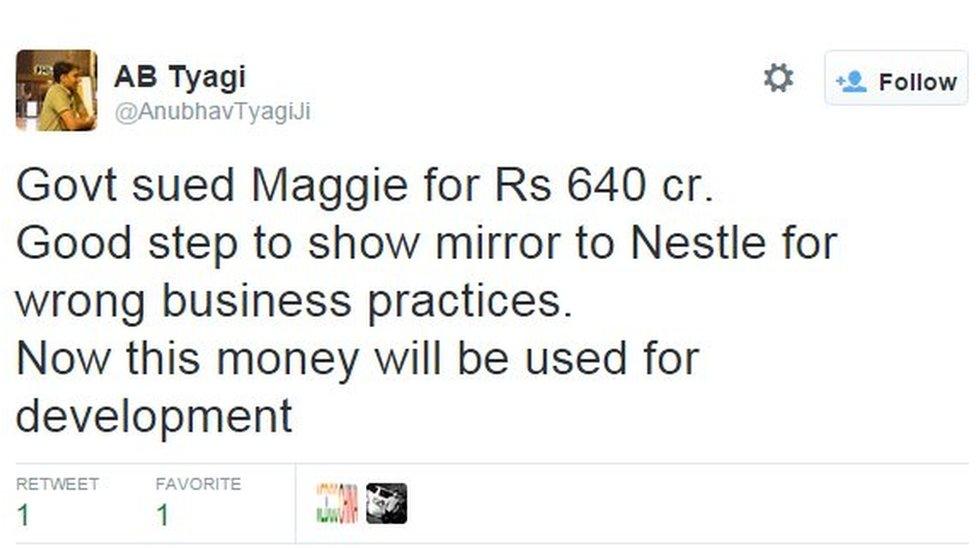
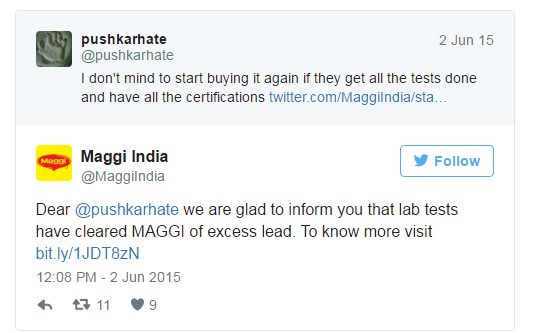
This realisation enabled the brand to tailor its response in a certain manner.
In order to show the significance of social listening during times of brand crisis, Maggi refrained from utilising social media just for brand advertising and used it to gain insights on sentiments of the users and engage in meaningful conversations during the time of brand absence.
Famous Marketing Campaigns of Maggi
#WeMissYouToo Campaign
In period of ban, Maggi does not solely rely on television advertising. Maggi noticed people still discussing Maggi and how much they missed it. So Maggi takes this as an opportunity to reconnect with their audience.
Maggi launched campaign #WeMissYouToo to keep brand conversation alive. Maggi create emotional video content that reflects feelings of consumers who missed their favourite noodles.
Why this campaign work?
- It was a reaction to real discussions about consumer behaviour and needs.
- It created situations that evoked emotions, but not aggressive advertising of the product.
- It motivated consumers to continue interaction with the brand.
#WelcomeBackMaggi Campaign
After completing all testing process, Maggi came back to the Indian market on 9 November 2015. The company introduced campaign called #WelcomeBackMaggi to acknowledge the excitement generated by its comeback into the market.
One of the best activities associated with the comeback of Maggi was its tie-up with Snapdeal.
The company distributed special welcome kits via an online flash sale exclusively through Snapdeal to celebrate the comeback. These welcome kits had Maggi noodles and small branded gifts for the occasion.
The campaign received good response including:
- The sale of 60,000 welcome kits.
- The sale of the initial batch was finished within five minutes.
- Nestle India report claimed the presence of almost 10 lakh people to pre-book for this purpose.
- The activity received more attention due to the presence of newspapers and online media as well.
This campaign turned the anticipation of the product’s comeback into online sales for the company as well.
Marketing Mix of Maggi (4P’s Analysis of Maggi)
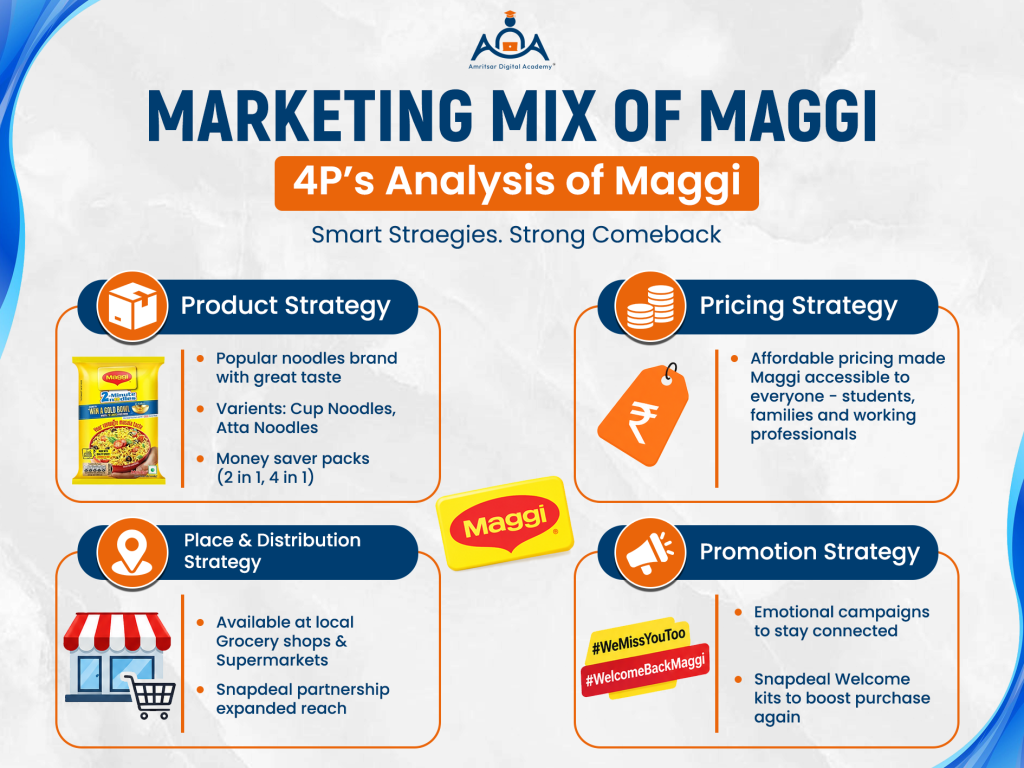
4Ps of marketing explain business foundation models which are price, product, place and promotion. 4Ps analysis of Maggi shows how brand basics supported recovery.
Product Strategy of Maggi
Maggi is one of the most hot selling products of Nestlé. Consumers loved its taste and it is affordable to everyone. Their products mainly come into the category of noodles, soups, and seasoning. Its product packing and labelling help product to promote. Maggi also introduced money saver multi packs in form of 2 in one and 4 in one packs. Also they added new variants such as cup noodles and atta noodles to compete with their competitors.
Pricing Strategy of Maggi
Maggi followed affordable price strategy so that the product could be accessed by every group of consumers. Because the packaging was of convenient size, the product was appropriate to be sold among the students, families and working people as it could be bought at minimal cost. Such pricing policies enabled the organisation to maintain mass market profile and become an everyday snack.
Place and Distribution Strategy of Maggi
Maggi’s network of distribution was also key to its recovery. It was easy to buy Maggi through local grocery shops and supermarket stores in the market before the ban, and bringing back its distribution was another step that was necessary after it came back to the market.
Snapdeal partnership also provided yet another platform on which Maggi could be sold but also traditional retail outlets helped in making it part of routine shopping again.
Promotion Strategy of Maggi
Maggi promotional strategy is combo of emotional advertising, digital engagement and sales promotions. The #WeMissYouToo campaign succeeded in keeping the consumer engaged while it was not around, and on its return the #WelcomeBackMaggi campaign created excitement among the consumers.
The Snapdeal Welcome Kits offered the consumer something special so that the consumer would again buy Maggi.
Altogether the above activities were used to communicate with the consumers at various points in the brand’s journey of recovery.
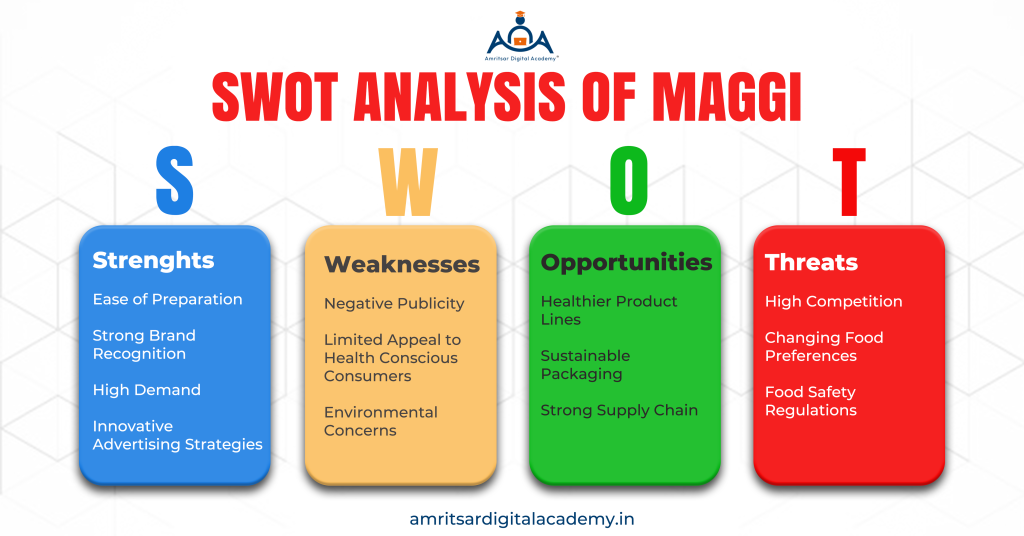
SWOT Analysis of Maggi
S = STRENGTHS
W = WEAKNESSES
O= OPPORTUNITIES
T= THREATS
Strengths
- Ease of preparation: Maggi owns brand statement ‘2 minute noodles’. People prefer Maggi for travelling and living away from home because it is easy to cook meal. Even 15 year child can cook Maggi.
- Strong brand recognition: Maggi is well known brand all over the world. Its slogan 2 minute noodle and brand name meant same thing. Maggi has built strong brand recognition through taste and emotional connection with consumers.
- High demand: For every easy snacking option, people opt for Maggi. Maggi has very high demand as compared to their market rivals.
- Innovative advertising strategies: Maggi smartly uses its taglines on their product and its emotional connecting advertising making it cultural favourite.
Weaknesses
- Negative publicity: Due to Maggi ban in 2015, it strongly impact on consumers mind which led to quick loss of heavy sale ratio. Sompe people still thinking of Maggi as non healthier meal due to food safety controversies.
- Limited appeal to health conscious consumers: Now people shift their mindset towards healthy meal options. So its audience is limited to only consumers who are not that much health conscious. This may affect sales of product.
- Environmental concerns: People become more aware of environment and Maggi is criticised due to its non-biodegradable packaging.
Opportunities
- Healthier product lines: Maggi can launch more healthier variants in their product line to target health conscious market audience. This helps them to compete with their rivals and maintain their market position on top.
- Sustainable packaging: In new era, people like sustainable brands that don’t affect environment. It helps to increase market share among sustainable consumers.
- Strong supply chain: Maggi can use more innovative and trending marketing strategies to strong their supply chain. With strong supply chain, it can reach more audience.
Threats
- High Competition: Maggi is not only single product selling noodles in market.There are many competitors of Maggi such as Yippee, Top Ramen, Chings and other noodles to compete with them to maintain their market position.
- Changing food preferences: Consumers never stick to one option, their preference changes according to time, trend and demand. So maintaining demand for the product is difficult for the brand especially when consumers are looking for healthier options.
- Food safety regulations: Maggi suffers from government bans and health laws. So changes in food safety regulations also affect brand image and revenue.
What Businesses Can Learn From Maggi’s Marketing Strategy?
This Maggi case study gives practical lessons for digital marketers, businesses and marketing students.
- Brand takes years to build trust: Companies spend decades to build trust among their customers but one single piece of negative publicity ruins that trust in one day.
- Analyse customer sentiments: Watch what people say about your products/services during crisis. That helps brands to identify concerns before they become bigger problems.
- Use emotional marketing strategy: Make coming back easy after big allegations when you are already emotionally connected with your audience. Maggi #WeMissYouToo campaign is best example of emotional marketing strategy for every business.
- Answer real concerns of consumers: Instead of only relying on promotional activities, address real issues and gain trust of your customers. Maggi shows real lab tests to their consumers to rebuild their trust.
- Effective use of digital marketing strategies: Using strong digital marketing strategies helps brands to be in conversation for months. Maggi marketing strategies show how brand can rebuild its market position after facing so many crises.
| Want to Create Marketing Strategies Like These? Learn practical digital marketing skills and build your career with Amritsar Digital Academy. |
Conclusion
Maggi comeback after 2015 ban shows how brand can rebuild its position with the help of proper planning, marketing strategies and communication. It also shows us the way a brand can go to the extent of dealing with all types of regulatory requirements and how it can engage consumers with emotional campaigns as well as make a relaunch supported by both traditional and digital marketing strategies.
Another way it is clear that consumer confidence is something very important is with the response of customers to Snapdeal Welcome Kits.
The most important thing about the Maggi case study is that we are reminded the importance of long term success of brand in terms of quality of product, consumer trust and communication.